Showing posts with label steam engineer. Show all posts

Thursday, 26 February 2026

Boiler ; major field failures realities

Technical deep dive into each failure mechanism — from thermodynamics, heat transfer, and materials engineering perspectives — with peer-reviewed journal references for further study.

๐Ÿ”ฅ 1️⃣ Defective Superheater Design

(Poor material selection / excessive operating temperature)

Image

Image

Image

Engineering Mechanism

Superheater tubes operate in the highest flue gas temperature zone. If:

  • Wrong material grade is selected

  • Allowable stress is underestimated

  • Flue gas temperature exceeds design

  • Steam flow is insufficient

Then tube metal temperature (TMT) exceeds metallurgical limits.

Material Science Aspect

At elevated temperatures:

  • Yield strength decreases

  • Time-dependent deformation (creep) begins

  • Carbide coarsening reduces creep strength

  • Grain boundary voids form → creep rupture

For ferritic steels like T91 (9Cr-1Mo), creep becomes critical above ~540–580 °C.

Failure Mode

  • Bulging

  • Longitudinal rupture

  • Fish-mouth opening

  • Thick-lip rupture (classic creep failure)

Journal References

• Viswanathan, R. (2001). Damage mechanisms and life assessment of high-temperature components. International Journal of Pressure Vessels and Piping, 78(7–8), 481–495.
• Parker, J.D. (2007). Creep damage accumulation in power plant steels. Engineering Failure Analysis, 14, 150–167.
• Masuyama, F. (2001). History of power plants and progress in heat resistant steels. ISIJ International, 41(6), 612–625.

๐Ÿ”„ 2️⃣ Poor Internal Circulation

(Evaporator overheating / furnace tube failure)

Thermodynamic Mechanism

In natural circulation boilers, flow depends on density difference between:

  • Hot risers (steam-water mixture)

  • Cold downcomers

If circulation ratio drops:

  • Steam blanketing occurs

  • Local dry-out develops

  • Heat transfer coefficient drops sharply

Result:
Tube metal temperature spikes.

Heat Transfer Principle

When nucleate boiling transitions to film boiling:

Heat transfer coefficient decreases dramatically
→ metal temperature rises rapidly
→ short-term overheating failure

Failure Mode

  • Short-term overheating

  • Thin-lip rupture

  • No significant bulging

  • Rapid failure

Journal References

• Collier & Thome (1994). Convective Boiling and Condensation. Oxford Science.
• Bergles, A.E. (1981). Boiling heat transfer. Advances in Heat Transfer, 15, 1–89.
• Dutta, P. et al. (2009). Analysis of boiler tube failure due to internal flow problems. Engineering Failure Analysis, 16, 193–201.

๐Ÿ”ฅ 3️⃣ Excessive Furnace Heat Flux

(Burner misalignment / flame impingement)

Combustion & Radiation Effect

Radiant heat transfer in furnace follows:

q ∝ T⁴ (Stefan–Boltzmann law)

Small increase in flame temperature
→ exponential increase in radiant heat flux.

If burner setup is poor:

  • Flame impingement on tubes

  • Uneven heat distribution

  • Local hot spots

Metallurgical Consequence

Localized overheating causes:

  • Oxide scale thickening

  • Rapid creep damage

  • Metallurgical phase transformation

Journal References

• Baukal, C.E. (2004). Heat transfer in industrial combustion. CRC Press.
• Kumar, S. et al. (2013). Failure investigation of superheater tube due to flame impingement. Engineering Failure Analysis, 28, 30–38.

๐Ÿ’ง 4️⃣ Poor Water Treatment Management

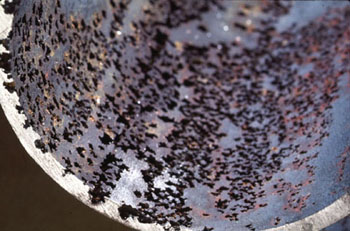
Image

Image

Image

Chemical & Heat Transfer Mechanism

Poor chemistry control leads to:

  • Scale deposition (CaCO₃, Mg salts)

  • Caustic gouging

  • Hydrogen damage

  • Oxygen pitting

Thermodynamic Impact

Scale acts as thermal insulation:

Even 1 mm scale → metal temperature increase by 50–100°C.

Higher metal temperature accelerates creep exponentially.

Failure Modes

  • Under-deposit corrosion

  • Caustic embrittlement

  • Hydrogen blistering

  • Localized overheating

Journal References

• Dooley, R.B. & Bursik, A. (2011). Steam purity for turbine operation. PowerPlant Chemistry Journal.
• French, D.N. (1993). Boiler tube failures: theory and practice. Journal of Pressure Vessel Technology, ASME.

⬇️ 5️⃣ Downcomer Instability & Carryover

Fluid Dynamics Mechanism

Instability in downcomers can cause:

  • Water level fluctuation

  • Steam-water separation inefficiency

  • Carryover of dissolved solids into steam

When contaminated steam enters superheater:

  • Deposits form inside tubes

  • Heat transfer reduces

  • Tube metal temperature increases

Internal fouling + high flue gas temperature
= classic superheater overheating failure.

Journal References

• Hewitt, G.F. (2008). Two-phase flow and boiling in circulation systems.
• Rayaprolu, K. (2009). Boilers for Power and Process. CRC Press.

⏳ 6️⃣ Tube Material Exceeding Design Life

Creep Life Consumption

Creep damage accumulates according to:

Larson-Miller Parameter (LMP):

LMP = T (C + log t)

Where:
T = absolute temperature
t = rupture time

If operating hours exceed design creep life:

  • Grain boundary cavitation develops

  • Microvoid coalescence occurs

  • Final rupture happens even at normal stress

Journal References

• Larson, F.R. & Miller, J. (1952). Time-temperature relationship for rupture and creep stress. Transactions ASME.
• Viswanathan, R. (1989). Life assessment of high temperature components. ASM International.

๐Ÿ“Š Summary of Failure Mechanisms

Failure CauseDominant ScienceFailure Type
Wrong material / high TCreep mechanicsBulging rupture
Poor circulationBoiling heat transferShort-term overheating
Flame impingementRadiative heat transferLocal hot spot rupture
Poor water chemistryCorrosion + insulation effectUnder-deposit failure
Carryover contaminationInternal foulingSuperheater overheating
Design life exceededCreep-fatigue interactionEnd-of-life rupture

๐ŸŽฏ Final Engineering Insight

Most boiler tube failures are thermo-metallurgical in nature:

They occur when:
Heat input > Heat removal

or
Stress > Allowable creep strength

or
Chemistry control fails

Effective root cause analysis requires:

✔ Metallography
✔ Hardness testing
✔ Oxide scale thickness measurement
✔ SEM fractography
✔ Operating history review
✔ Water chemistry records

How frequent start–stop operation affects a boiler with superheater tubes


Here’s a detailed engineering-level explanation of how frequent start–stop operation affects a boiler with superheater tubes — covering thermodynamics, material behavior, and failure mechanisms, supported by journal references.


1) Thermodynamic & Operational Basics of a Boiler with Superheater

A boiler with a superheater converts chemical energy → thermal energy → mechanical/steam energy:

  1. Combustion produces hot flue gases

  2. Water absorbs heat in boiler tubes → becomes saturated steam

  3. Saturated steam flows to superheater tubes where it continues absorbing heat from flue gas and becomes superheated steam (higher temperature at same pressure)
    → improved efficiency, dryness, and energy content.
    Superheater tubes operate at the highest temperatures in the boiler. (American Chemical Society Publications)

Key Thermo Concepts

  • Heat transfer & temperature gradients — steep changes during start/stop create large variations in tube wall temperature.

  • Specific heat & steam production — at startup, steam flow is low while tube temperature may rapidly rise.

  • Steam flow cooling effect — steady steam flow cools tube metal; interruption increases metal temperature.
    These effects together create significant thermal stress.


2) Material Engineering: Behavior at High Temperature

A. Creep

Creep is time-dependent plastic deformation under stress and temperature.

  • At high temperature (typical superheater: 500+ °C), materials like Cr-Mo, Super-304H, T91 steel begin to creep.

  • Microstructural mechanisms: grain boundary sliding, void formation, dislocation motion.

  • Creep reduces allowable stresses and induces gradual deformation/bulging.
    → This was highlighted in a Metals journal paper analyzing creep in superheater steels: creep relaxes stress over long time, and temperature spikes accelerate it. (MDPI)

B. Fatigue & Thermal Fatigue

Cyclic thermal loading (heat up/cool down):

  • Causes thermal fatigue — alternating expansion/contraction produces cyclic stress.

  • Metallurgical damage includes micro-cracks, grain boundary separation.

In Engineering Failure Analysis, controlled thermal cycles on 9Cr-1Mo steel showed clear crack initiation due to repeated thermal cycles, and failure life correlates to thermal strain cycles (Coffin-Manson behavior). (ScienceDirect)

C. Creep-Fatigue Interaction

When thermal fatigue and creep occur together:

  • Damage is synergistic — creep weakens grains and increases damage from fatigue cycles.

  • Fractographic analysis of superheater creep-fatigue interaction revealed complex failure modes and interaction between deformation and cracking mechanisms. (ScienceDirect)

D. Oxidation & Corrosion

At superheater temperatures, oxidation occurs:

  • Formation of oxide scales changes local microstructure.

  • Spallation and deposition create stress concentrations.
    A recent study found alternating thermal stresses from high temperature cycles promote oxide film cracking and spallation, accelerating failure. (ScienceDirect)


3) Start–Stop Operation: Thermal & Material Stress Mechanisms

A. Temperature Oscillations Lead to Thermal Stress

Every start:

  • Tube walls heat rapidly

  • Internal steam pressure increases

  • Differential temperature across wall causes elastoplastic deformation

Every stop:

  • Tube walls cool rapidly

  • Contraction occurs

  • Stress reverses direction

This large temperature gradient ฮ”T induces repeated tensile/compressive stress cycles → thermal fatigue.


B. Steam Flow Variations

At startup or shutdown:

  • Low steam flow means less convective cooling on tube inner surface

  • Heat from flue gas raises metal temperature locally faster than design intended

  • Leading to overtemperature conditions and enhanced creep rate.

This is supported by flexible operation studies showing rapid load changes significantly shorten component life via creep and fatigue damage accumulation. (American Chemical Society Publications)


C. Material Response: Creep + Fatigue

With frequent cycling:

  • Creep damage accumulates faster due to higher effective stress and temperature exposure

  • Fatigue cracks initiate at grain boundaries or stress concentrators

  • Creep-fatigue interaction accelerates failure progression compared to steady operation.


4) Failure Mechanisms Observed in Practice

Journal case studies report actual fail modes in superheater tubes:

• Creep Rupture

Long exposure at high stress and temperature leads to microvoids and final rupture, even without external loads. (ScienceDirect)

• Fatigue Cracks

Repeated heating/cooling causes longitudinal fissures, microcrack propagation, and eventual tube opening. (ScienceDirect)

• Oxidation & Corrosion Coupled with Fatigue

Deposits and oxide scales can accelerate microstructural damage, especially combined with cyclic stresses. (American Chemical Society Publications)


5) Thermo-Mechanical Stress Development (Material Perspective)

Elastic & Plastic Stress Components

  • Thermal expansion generates elastic stress initially.

  • With repeated cycling, plastic strain accumulates.

  • High temperature makes materials softer → more creep deformation.

  • Effectively, the material experiences ratcheting — progressive deformation with each cycle.

Thermal stresses are calculated using finite element methods in research to predict stress distribution under non-steady conditions. (ScienceDirect)


6) Quantifying the Damage: Lifetime Estimation

Damage mechanisms (creep + fatigue) can be evaluated by:

  • Coffin-Manson relations (for fatigue life vs thermal strain range)

  • Creep damage models (time-temperature dependent)

  • Creep-fatigue interaction maps (stress/temperature domain)

These models allow design engineers to estimate remaining life for given start–stop cycles.


7) Summary

CauseMaterial EffectFailure Mechanism
Rapid temperature changeThermal stress & strainThermal fatigue cracks
Prolonged high T & stressTime-dependent plasticityCreep deformation/rupture
Cyclic operationInteraction of mechanismsCreep-fatigue failure
Oxidation/scalesMicrostructural weakeningCorrosion-assisted cracking

8) Journal References for Further Reading

You can search the following papers for deep academic detail:

  1. Piotr Duda et al.Analysis of creep phenomena in boiler superheaters (Metals) — discusses creep behavior and allowable temperature conditions. (MDPI)

  2. Engineering Failure Analysis (2021) – creep-fatigue interaction failure in superheaters. (ScienceDirect)

  3. Thermal fatigue of 9Cr-1Mo tubes – experiment/numerical study on fatigue life. (ScienceDirect)

  4. Oxide film failure under cyclic thermal stress – shows how fluctuating stress promotes oxide cracking. (ScienceDirect)

  5. Flexible operation effects on damage – emphasizes how load cycling increases creep/fatigue damage. (American Chemical Society Publications)


Sunday, 21 December 2025

Tugas Jurutera Stim

Kilang sawit pertama saya sebagai kadet jurutera membina pengalaman sebagai jurutera stim

Penjelasan jelas & profesional tentang peranan Steam Engineer (Jurutera Stim) 


๐Ÿ‘ท‍♂️ Peranan Utama Steam Engineer (Jurutera Stim)

Steam Engineer ialah orang kompeten yang diperakui oleh JKKP (DOSH Malaysia) yang bertanggungjawab memastikan dandang stim dan sistem berkaitan beroperasi dengan selamat, cekap dan mematuhi undang-undang.

Peranan ini bukan sekadar “menjaga boiler”, tetapi penjaga keselamatan, kebolehpercayaan dan kesinambungan operasi loji.


๐Ÿ”ฅ 1. Keselamatan & Pematuhan Undang-Undang

Steam Engineer bertanggungjawab untuk:

  • Memastikan operasi dandang mematuhi Akta Keselamatan dan Kesihatan Pekerjaan serta Peraturan Loji yang Menghendaki Perakuan Kelayakan (CF)

  • Mengawal parameter kritikal seperti:

    • Tekanan

    • Suhu

    • Paras air

  • Mengelakkan risiko letupan, over-pressure dan kegagalan mekanikal

  • Menghentikan operasi jika keadaan tidak selamat

๐Ÿ‘‰ Keselamatan manusia dan aset adalah keutamaan utama.


⚙️ 2. Operasi Dandang & Sistem Stim

Steam Engineer:

  • Menyelia operasi harian:

    • Boiler

    • Economiser

    • Superheater

    • Steam header & distribution

  • Menentukan:

    • Start-up dan shutdown dilakukan secara betul

    • Beban stim diagihkan dengan selamat

  • Mengawal kecekapan pembakaran dan pemindahan haba


๐Ÿงช 3. Kawalan Kualiti Air & Stim

Air adalah “nyawa” boiler.

Steam Engineer memastikan:

  • Raw water & boiler feed water memenuhi spesifikasi

  • Rawatan kimia dilakukan dengan betul:

    • pH

    • TDS

    • Hardness

    • Oxygen control

  • Blowdown dikawal untuk mengelakkan:

    • Scaling

    • Corrosion

    • Foaming & carryover


๐Ÿ”ง 4. Penyelenggaraan & Kebolehpercayaan

Steam Engineer:

  • Merancang dan menyelia:

    • Preventive maintenance

    • Predictive maintenance

  • Menganalisis kegagalan:

    • Tube leak

    • Overheating

    • Corrosion fatigue

  • Berurusan dengan:

    • Inspector JKKP

    • Vendor

    • Contractor


๐Ÿ“Š 5. Dokumentasi & Audit

Steam Engineer bertanggungjawab ke atas:

  • Log sheet operasi

  • Rekod ujian keselamatan

  • Rekod pemeriksaan & pembaikan

  • Penyediaan dokumen untuk:

    • Pemeriksaan JKKP

    • Pembaharuan CF

๐Ÿ“Œ Jika rekod gagal → CF boleh ditarik balik.


๐Ÿ‘ฅ 6. Kepimpinan & Pembangunan Operator

Steam Engineer juga berperanan sebagai:

  • Ketua teknikal kepada operator boiler

  • Mentor & trainer

  • Penguatkuasa disiplin operasi selamat (SOP & PTW)


๐ŸŒฑ 7. Kecekapan Tenaga & Kelestarian

Steam Engineer menyumbang kepada:

  • Penjimatan bahan api

  • Pengurangan kehilangan haba

  • Optimasi blowdown & condensate recovery

  • Sokongan kepada sasaran ESG & sustainability


๐ŸŽ“ Ringkasan Peranan Steam Engineer

✔ Penjaga keselamatan loji stim
✔ Pakar operasi & kejuruteraan boiler
✔ Pemegang tanggungjawab undang-undang
✔ Peneraju kecekapan & kebolehpercayaan
✔ Mentor kepada operator & pasukan teknikal

Boiler boleh automatik, tetapi keselamatan memerlukan manusia yang kompeten.

#SteamEngineer #dosh #jkkp #KembaraInsan #blog 

Friday, 31 October 2025

Apa tu ASWP dan MAWP? Kenapa DOSH beri ASWP lebih rendah dari MAWP?

Jom Dukun Boiler kupas sedikit. ASWP nama panjangnya adalah Authorised Safe Working Pressure manakala MAWP nama panjangnya adalah Maximum Allowable Working Pressure. 

Ada mazhab mengatakan ASWP diberi lebih rendah dari MAWP disebabkan boiler itu dibuat dari negara China atau ada juga mazhab kata boiler tu tak follow code lah dan ada juga mazhab cakap DOSH takkan bagi sama sbb mana boleh dpt 100% So kene rendahkanlah sedikit. 

Meh Dukun Boiler beri pencerahan. Sebelum tu kita kene tahu asal usul pengiraan sesebuah boiler. Bila nak buat boiler, owner akan bagitau berapa Operating Pressure yang diperlukan kepada Engineering Consultant Firm, maka pihak engineering consultancy akan buat pengiraan dengan mengambil kira faktor Pressure drop across piping dan maka keluarlah nilai yang dipanggil Working Pressure. 

Nilai Working Pressure ni akan diberikan kepada pihak manufacturer atau OEM untuk design berapa minimum Pressure yang diperlukan untuk merekabentuk sesebuah boiler. Dari pada calculation yang dibuat menggunakan formula dalam gambar, maka setiap komponen akan dpt Thickness minima (Tmin) dan dari Tmin tu ia perlu di compare dengan ketebalan plate yang ada dlm market. Contoh Tmin adalah 17mm tetapi dalam market hanya ada plate ½" dan ¾". ½" bersamaan 12.5mm manakala ¾" adalah 19mm. Maka plate 19mm dipilih dan jika dibuat reverse calculation kita akan dapati "new pressure" akan lebih tinggi dari Design Pressure. "New Pressure" inilah dipanggil MAWP.

Memandangkan pada peringkat awal calculation, semua Tmin dikira berdasarkan Design Pressure so pihak DOSH tetap akan lulus tekanan kerja selamat (ASWP) untuk boiler itu hanya pada Design Pressure bukannya pada MAWP. so lebihan ketebalan itu bolehlah di kategorikan sebagai corrosion allowance.

Harap semua sahabat jelas dengan penjelasan ini. Dan kita sama2 sayang boiler kita

#LOVEBOILER

DUKUN BOILER 
31/10/2025

Gambar kenangan dikongsi oleh Tuan Perumal sempena hari lahir Tn Hj Ir Ts Dr Azmer Shamsuddin hari ini.

Monday, 13 October 2025

Ethics, Integrity, Safety, Conflict of interest, Environmental, Role of a Professional Engineer in society

1. Engineering Ethics and Integrity 

Engineering ethics and integrity form the cornerstone of the engineering profession. Engineers are entrusted by society to apply their technical knowledge responsibly for the benefit of mankind. Without integrity, the credibility and trust placed in the profession would quickly erode.

An ethical engineer must demonstrate honesty, fairness, and transparency in all professional dealings. Integrity requires doing what is right even when no one is watching, and being willing to take responsibility for one’s decisions. For example, an engineer must never approve or certify work that does not meet design standards or safety requirements, even under pressure from clients or contractors.

Ethical behavior also includes giving credit where it is due, avoiding plagiarism, and maintaining confidentiality of sensitive information. When preparing reports, specifications, or cost estimates, accuracy and truthfulness are essential. Any form of falsification or misrepresentation is strictly against the Code of Ethics under the Board of Engineers Malaysia (BEM).

Integrity also means avoiding conflict of interest and maintaining independence of judgment. Engineers must act in the best interest of the public and their employer while upholding safety, quality, and professional standards.

In conclusion, ethics and integrity are not optional virtues but professional obligations. Upholding them preserves public confidence and the dignity of the engineering profession. Every Professional Engineer must remember that technical competence alone is not enough — it must be guided by strong moral values and unwavering integrity.

2. Public Safety, Health, and Welfare 

The foremost duty of every engineer is to protect public safety, health, and welfare. Engineering works directly impact people’s lives — from bridges and buildings to water supply systems and electrical networks. Any negligence or oversight can lead to disastrous consequences.

A Professional Engineer must ensure that every design and construction complies with relevant codes, standards, and statutory requirements. Safety considerations must always take precedence over cost or schedule. For instance, selecting cheaper materials that compromise structural strength or bypassing testing procedures would be unethical and dangerous.

Engineers should also promote a safety culture within the organization by conducting risk assessments, implementing safe work procedures, and providing continuous safety training. In addition, regular inspection, preventive maintenance, and proper documentation are vital to minimize hazards.

The Street, Drainage and Building Act, the Uniform Building By-Laws, and other relevant regulations in Malaysia serve as legal frameworks to safeguard public safety. However, ethical responsibility goes beyond compliance — it is about having the moral courage to stop unsafe work and to speak out when public welfare is at risk.

In summary, engineers must always prioritize human life and welfare above all else. Public safety is the heart of professional engineering practice. A true engineer acts with diligence, competence, and conscience to ensure that every project contributes to the well-being of society.


3. Conflict of Interest 

A conflict of interest occurs when an engineer’s personal or financial interest could improperly influence professional judgment. If not managed properly, it can lead to ethical violations, loss of credibility, and damage to the profession’s reputation.

Examples include situations where an engineer has ownership in a contracting company being considered for a project, or when a close relative is employed by a supplier whose product is under evaluation. Accepting gifts, commissions, or personal favors from contractors or clients can also create perceived or real conflicts.

To act ethically, the engineer must disclose any potential conflict of interest to all relevant parties. Transparency is key. If necessary, the engineer should withdraw from the decision-making process to maintain impartiality. The BEM Code of Professional Conduct explicitly requires engineers to avoid circumstances where personal interest conflicts with professional duty.

For instance, if an engineer is part of a tender evaluation committee and discovers that one of the bidders is a relative’s company, the correct course of action is to declare the relationship and excuse oneself from the evaluation.

Ultimately, professionalism demands that engineers base their decisions solely on technical merit and public interest. By recognizing and managing conflicts openly, engineers preserve the trust and integrity that form the foundation of the profession.


4. Environmental and Sustainability Obligations 

In today’s world, engineering cannot be separated from environmental and sustainability responsibilities. Engineers play a critical role in developing infrastructure and technology that meet present needs without compromising the ability of future generations to meet theirs.

A Professional Engineer must always consider environmental impact in every stage of a project — from planning and design to construction and operation. This includes minimizing pollution, managing waste, conserving energy and water, and promoting the use of renewable resources. Compliance with the Environmental Quality Act and other environmental laws is mandatory, but ethical practice goes beyond mere compliance.

For example, an engineer can design energy-efficient systems, recommend sustainable materials, or implement green construction practices such as recycling and resource recovery. Life-cycle costing and design for maintainability can further enhance sustainability.

Sustainability also includes social and economic aspects — creating projects that are affordable, socially beneficial, and environmentally sound. Collaboration with environmental consultants and local authorities ensures that projects align with sustainable development goals.

In conclusion, environmental stewardship is a moral and professional duty. Engineers are custodians of natural resources, and every decision they make should balance progress with preservation. Through sustainable design and responsible practice, engineers help build a cleaner, safer, and more resilient future for all.

5. Role of a Professional Engineer in Society

A Professional Engineer (Ir.) holds a position of trust and responsibility within society. The title signifies not only technical competence but also a deep commitment to public service, ethical conduct, and leadership.

Engineers contribute significantly to national development through the design, construction, and maintenance of essential infrastructure such as roads, bridges, power systems, and communication networks. Their work improves the quality of life and supports economic growth.

Beyond technical duties, Professional Engineers must uphold high ethical standards, ensuring that all work complies with safety and environmental regulations. They should also mentor young engineers, share knowledge, and promote professionalism within the industry.

Engineers play an important advisory role to policymakers and the public. They must communicate complex technical issues in an understandable way and provide sound, unbiased opinions. During times of crisis, such as structural failures or environmental disasters, society relies on engineers for competent and honest assessment.

The professional title “Ir.” represents integrity, accountability, and service to the community. As representatives of the profession, engineers must continuously update their knowledge through lifelong learning and actively participate in professional bodies such as IEM and BEM.

In summary, the role of a Professional Engineer extends beyond solving technical problems — it encompasses leadership, ethical conduct, and a commitment to advancing society. Through responsible and dedicated practice, engineers earn the public’s trust and contribute meaningfully to national and human progress.

#ProfessionalEngineer

✏️ Essay: How Ethics Influence Engineering Decisions

Ethics play a fundamental role in every engineering decision. While technical knowledge determines what can be done, ethics guide what should be done. In other words, ethical principles ensure that an engineer’s actions serve the public interest, protect safety, and uphold the dignity of the profession. Every engineering decision — whether in design, operation, or management — must therefore be governed by integrity, honesty, and responsibility.

Engineering projects often involve multiple constraints such as cost, schedule, and performance. In such situations, ethical values help engineers make balanced decisions without compromising safety or public welfare. For example, when selecting materials or designing pressure systems, an ethical engineer will always ensure compliance with standards such as ASME, API, and local regulations, even if cheaper or faster options exist. Ethics remind us that public safety and environmental protection come before commercial advantage.

In the palm oil refinery and solvent extraction industry, ethical judgement is critical because we deal with high-temperature operations, flammable solvents, and pressure equipment. An engineer guided by ethics will refuse to start up a system if safety interlocks are not tested, even under pressure from management to meet production targets. Such decisions demonstrate accountability and respect for human life — the highest priority under the BEM Code of Ethics.

Ethics also influence decisions related to resource use, environmental impact, and sustainability. Engineers must ensure that waste discharge, emissions, and energy consumption remain within legal and responsible limits. For instance, when designing a solvent recovery system or upgrading a boiler, I always consider energy efficiency and emission reduction, not just cost savings. This reflects the ethical duty to protect both people and the environment.

Furthermore, ethical behaviour fosters trust and teamwork. When engineers are transparent in their decisions, document their actions honestly, and acknowledge limitations, they build credibility among colleagues, clients, and authorities. This trust is essential for long-term professional integrity.

In conclusion, ethics influence engineering decisions by providing the moral compass that guides our technical judgement. They ensure that every decision is made with honesty, fairness, and respect for safety and the environment. An engineer who upholds ethical principles not only ensures compliance with laws and standards but also safeguards public trust and the reputation of the engineering profession.

#ProfessionalEngineer #SteamEngineer #engineer #mrsm #usm

Tuesday, 16 September 2025

Boiler tube leaked, what need to do?


If a boiler tube leak occurs, procedures under DOSH (Department of Occupational Safety and Health, Malaysia) must be strictly followed, since boilers fall under the Factories and Machinery Act (FMA) 1967 and Occupational Safety and Health Act (OSHA) 1994

Here’s the typical procedure:


1. Immediate Actions (During the Incident)

  • Shut down the boiler safely

    • Stop firing immediately.

    • Trip fuel supply (oil, gas, biomass, coal).

    • Isolate steam flow and reduce pressure gradually.

    • Maintain feedwater if possible to prevent overheating of tubes.

  • Evacuate and secure the area

    • Prevent workers from entering the boiler house due to risk of scalding/steam release.

  • Report to the competent person (Boiler Engineer / Chargeman / Boilerman).


2. Notification to DOSH

  • Mandatory reporting:

    • A boiler tube leak is considered a dangerous occurrence under Factories and Machinery (Steam Boiler and Unfired Pressure Vessel) Regulations 1970.

    • The employer must notify the nearest DOSH office immediately (usually within 24 hours) and submit a written report (Form JKKP 6 or relevant form).

  • If injury or fatality occurs → also report under Occupational Safety and Health (Notification of Accident, Dangerous Occurrence, Occupational Poisoning and Occupational Disease) Regulations 2004.


3. Inspection & Investigation

  • The Competent Person (CP) (Boilerman/Steam Engineer certified by DOSH) must:

    • Inspect the boiler after shutdown and cooling.

    • Record tube failure location, cause, and possible hazards.

  • DOSH may send an officer for site inspection.

  • Root cause analysis must be conducted (erosion, corrosion, scaling, overheating, poor water treatment, etc.).


4. Repair & Rectification

  • Boiler tube repair/replacement must be carried out by a DOSH-approved Repairer (with approval under Regulation 8, FMA 1970).

  • After repair, the boiler must undergo:

    • Hydrostatic Test witnessed by DOSH Inspector or CP.

    • Non-destructive Testing (NDT) if required.

  • Repair report and test certificates must be submitted to DOSH.


5. Re-commissioning

  • Boiler cannot be restarted until written clearance from DOSH is obtained.

  • Competent Person must update Boiler Logbook (as required by law).

  • Preventive measures must be implemented (e.g., improved water treatment, scheduled inspections, NDT).


In summary:

  1. Shut down and make safe.

  2. Notify DOSH immediately.

  3. Investigate with Competent Person.

  4. Repair only by DOSH-approved repairer.

  5. Hydrostatic test + DOSH clearance before restarting.

#dosh #jkkp #malaysia #boiler #steamengineer #engineer

Sunday, 27 July 2025

The Quest for Boiler Efficiency

At a busy palm oil mill deep in rural Malaysia, stood an aging steam boiler that had served the plant faithfully for decades. The plant’s new engineer, Amir, had recently taken charge. He was young, ambitious, and determined to make the plant a model of efficiency.

On his first inspection, Amir recorded the As-Found Efficiency of the boiler. The readings were disappointing—far below the industry average. The boiler hissed and groaned under the load, wasting precious fuel. This baseline measurement, though discouraging, became his starting point.

Amir rolled up his sleeves. He began with a Tuned-Up Efficiency process—making operating adjustments, reducing excess air, and fixing small leaks. The results were encouraging. The boiler now burned cleaner, and the efficiency numbers climbed.

But Amir’s vision stretched further. He proposed installing advanced stack gas heat recovery systems and upgrading the burner controls. These measures pushed the boiler towards its Maximum Attainable Efficiency. The system performed at its peak, squeezing every bit of energy from the fuel.

However, the plant’s budget manager reminded Amir about reality—efficiency gains must also be cost-effective. So Amir carefully analyzed the costs versus the savings. Some expensive upgrades were shelved, focusing only on improvements that paid for themselves quickly. This practical approach achieved the Maximum Economically Achievable Efficiency—the perfect balance between performance and cost.

Months later, the mill’s fuel bills dropped significantly. The management praised Amir, not only for saving money but also for reducing environmental impact. The workers felt proud of their cleaner, smarter plant.

Amir looked at the boiler with satisfaction. To him, efficiency was not just about numbers—it was about understanding, persistence, and making the right choices at every step. The old boiler, once struggling, now worked like new, proving that with the right effort, even the oldest machines could shine again.

Saturday, 3 March 2018

Makkamaseh, Guru Boilerku


Makkamaseh. Bapanya Mohdridzwan Makkamaseh. Adalah guru Boiler saya yang pertama. Semasa saya pertama kali menjejak kaki ke Morisem Palm Oil Mill 'B'. Pertama kali jejak kaki di industri sawit. Pertama kali nampak boiler. Beliau ada lesen boilerman gred 2. Sebelum tahum 2000, JKKP benarkan pemegang pasport untuk mengambil lesen boiler, namun selepas itu ia dihentikan. Saya percaya, jika ia masih dibenarkan, beliau mampu capai lebih jauh daripada sekadar gred 2.

Kisah dia sebagai guru saya sangatlah indah. Setiap kali diaju soalan, sudah pasti dia akan panjang lebar menerangkan kepada saya sehingga saya betul - betul faham. Pada masa itu, FMA belum lagi diterjemah ke bahasa Melayu. Yang ada cuma berbahasa English. Saya terjemahkan kepada beliau, dan beliau akan jelaskan yang selebihnya.

Dalam bab menjaga kerja dan menjaga boiler, dialah yang paling sayang kepada boiler. Dialah orang pertama yang akan jumpa dengan pengurus jika apa sahaja masalah berkaitan boiler timbul. Dialah yang akan melakukan apa sahaja sehingga boiler dibaiki seperti sepatutnya. Komitmen, determination dan usaha yang tidak berbelah bagi kepada kerja.

2004 hingga 2006 bersama beliau, hinggalah saya mula berpindah ke kilang lain. Saban hari dan saban ketika, saya sentiasa berharap akan jumpa seorang boilerman yang sama seperti beliau. Sudah lebih 12 tahun, saya boleh katakan, saya belum lagi jumpa seorang boilerman berdedikasi seperti beliau.

Saya masih tidak mampu untuk membalas jasa beliau kepada saya. Semoga kamu dan keluarga dirahmati dan diberkati Allah selamanya. Doa saya selamanya untuk kamu. Terima kasih guruku.

Sunday, 18 June 2017

Operasi Kilang Sawit / Palm Oil Mill Operation

PALM OIL MILL IS THE HEART OF OIL PALM ESTATES.
Multitasking tasks in the mill produce multitasking managers and engineers. From basic fundamental of mechanical engineering, electrical, chemical, civil, human resources, accounting, marketing, quality management, public relation, teacher, lawyer and also actor! Yes. All in one. Congratulation if you are one of them!


  1. FFB Reception

    1. Weighbridge 60 mt. One/two clerk depend on one shift or two shift.
    2. FFB Transportation. Land & Water. 


      Less maintenance vehicles.

      Safety First dude!


      Ramp and Bin System.


  2. Road is the key of estates operation.
  3. Delivering the FFB from Estates to Mills is a challenging tasks to Planters. Whenever the loaded lorry arrive at mill's gate, millers should give respect to them by accepting their consignment to appreciate their hard work. Off course for the good FFB quality.
  4. Annual calibration by Metrology / Service provider - Avery.
  5. Grading.
 
    1. Grade the FFB quality based on MPOB Grading Manual-Latest 2015 Edition.
    2. 10 category FFB. Freshness. Unripe. Underipe. Ripe. Overipe. Long stalk. Empty. Rotten. Parthonorcorpic. Rotten. Wet.
    3. Oil palm profile. To determine the based OER. Year of planted. Weight of bunch.
    4. Based OER. 
    5. Penalty based on FFB quality 
    6. Certified FFB graders by MPOB.
    7. Helper 5 to 10 psn depend on the FFB daily reception.
    8. One loader to push the FFB.
    9. Good quality FFB. 95% ripe, 5% overipe, 5% underripe.
FFB Grading based on load <5mt : 50 bunches & >5mt : 100 bunches sampling.

Loose Fruit Analysis to determine the accuracy and measure the quantity of loose fruits.

 50 Bunches FFB Sampling by Graders.

100 Bunches Sampling

Old MPOB Grading Manual.
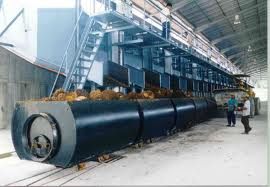
  1. Sterilization 
  2.  Vertical Sterilizer

    Spherical Sterilizer

    Spherical Sterilizer

    Continuous Sterilizer 

    Feeding of FFB to Vertical Steriliser

    Old style. FFB feeding to 3.5 mt Cages. Labor intensive of feedding ffb, arrranging cages and using of machinery such as loader and capstan. Safety issue and space. Maintenance of cages wear and tear.


    Spherical steriliser

    Horizontal sterilizer.

    Vertical sterilizer

    FFB Ramp, Conveyor system, Vertical Sterliser, EFB Hopper.

    1. Type of sterilizer. Horizontal. Vertical. Tilted. Spherical. Continuous. 
    2. Function : 
      1. To stop FFA increasing.
      2. To prepare the fruit/bunch for next processing.
    3. One peak, three peaks, multi peaks. 
    4. Pressure 3.2 bar or 120 deg C. 
    5. Cages size 3,5,7.5,10,15 or 20 mt each.
    6. Crane. 


    7. Dearation.
    8. Cycle.
    9. Capstan. 
    10. Cantilever. 
  3. Threshing

  4.  
    Shaft-less Thresher Drum


    Tippler use to handle the cage system.

    Tippler.
    Bunch Crusher using in Double Threshing System to reduce USB loss. Prepare the bunches for the EFB pressing or Shredding. 

    1. To separate the loose fruit and bunch.
    2. RPM.
    3. Type of threshing. with or without shaft.
    4. Single threshing or double threshing.
    5. Bunch crusher.
  5. Pressing
  6. Digester and Press


    Digester and Press

    Digester Schematic Diagram

    Digester Schematic Diagram


    Single and Double Screw Pressing

    Digester

    Cast steel screw press.

    1. Number and capacity of press determine the TPH of the mills.
    2. Capacity : 10. 15, 20, 25 mt/hr
    3. Twin screw. Cages. Screw. U liner. B plate. RH for replacement 700 to 1000 hrs.

    4. Digester. RPM. Long arm, short arm. S type. C type. Bottom plate. Temperature 95 deg C. Level 3/4. 3000 or 3500 liters capacity. 
    5. Losses. Nut breakage. Oil loss.
    6. Cake Breaker Conveyor.
  7. Nut Plant
    1. Ripple Mill. Nut breakage. Cracking Efficiency. Kernel breakage 12 to 15%.
    2. Nut Silo. Retention time.
    3. Hydrocylone or Claybatch.

      Cyclone system, Airlock using to separate the fiber, shell and kernel. Air or water separation.


      3 stages hydro-cyclone. 

      Nut Silo to retain the nut to cool down and prepare the nut before cracking. 

      Kernel Silo. Heating to reduce moisture below 7%.

      Hydrocyclone diagram.Cone and liner.

      Ripplemill. Cracking the nut. Determine the kernel breakage at range 10 to 15 % is the better option rather than cracking efficiency (96-98%). Reduce kernel loss at air separation. 

    4. Ripplermill.
    5. Kernel Bunker with load cell for weighing.
    6. Kernel losses. Shell. Dirt & Impurities.
  8. Kernel Plant
    1. Moisture.
    2. Kernel Silo. Heater.
  9. Kernel Storage
    1. Kernel bunker.
    2. To clean kernel silo and kernel bunker at least once a year to prevent fire. 
    3. Confined Space procedure to apply.
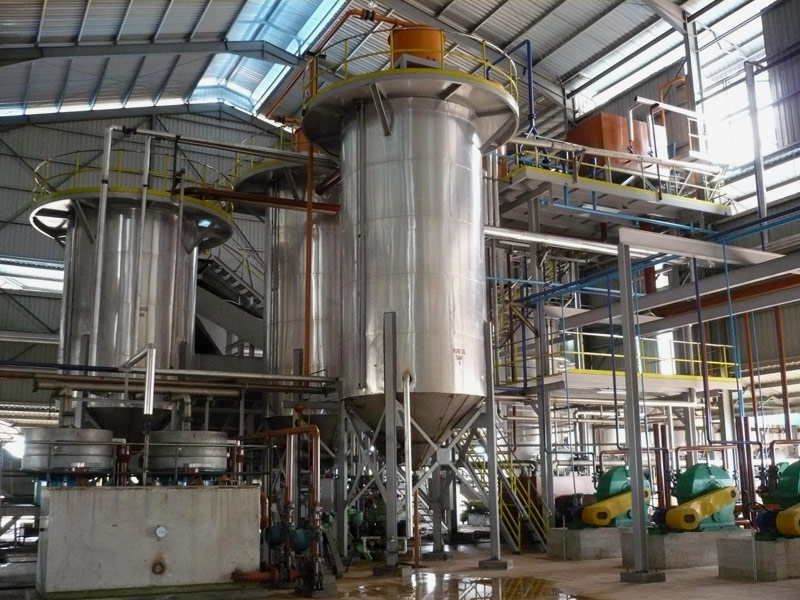
  10. Clarification 
    1. Vertical Clarifier. 

    2. Sand Trap.
    3. Pure Oil Tank
    4. Vacuum Drier. 
    5. Sludge Separator or Decanter.
    6. Sludge Tank.
      Vibrating Screen

      Decanter

      Vertical Clarifier. Pure Oil Tank. Crude Oil Tank. Sludge Separator.

      Sludge Separator

      Purifier
    7. Deoiling Tank.
    8. Sludge Pit.
    9. Condensate Tank.
  11. Vibrating Screen. Mesh 30 or 40.
  12.  EFB 
    1. Bunch Crusher. 
    2. EFB Press. Doe requirement to put roofing. Demand for solid fuel encourage more mills to install pressing and shredding. 
       
      Handling of EFB at mills required loader. Some mills put excavator to load the efb to lorry before transfer to estates as mulching.


       Efb Press recover max 0.2% oil from EFB. High kw requirement. Less demand for pressed EFB.

       
      Combination design of EFB Press and Shredding Machine. Moisture of shredded EFB at range 40 to 45%. High demand on shredded EFB for biomass power plants and palm oil refineries. Minimum 7 days to dry out the moisture before apply to boiler due to high moisture.  
    3. Shredded EFB
    4. Palleting Machine.
    5. Long fiber. 
      Palatalize EFB for boiler fuel exported to Japan & Korea at price RM250/mt. However, the demand is less due to lots of factors.
    6. Mulching


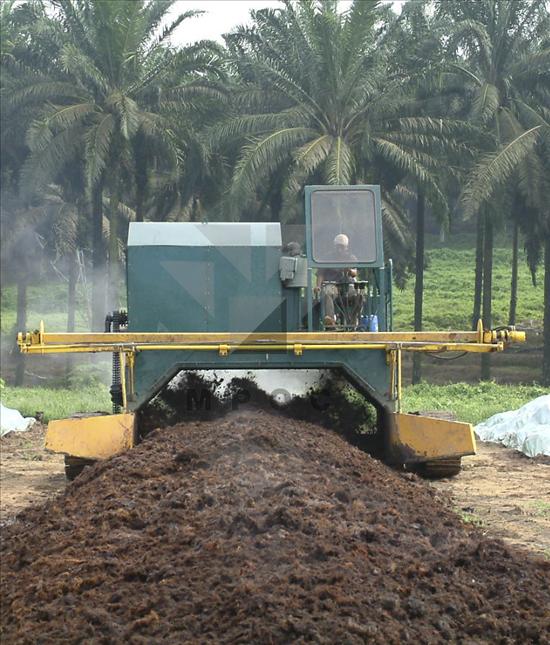
    7. Composting. 


      Nutrient contents of compost efb.
    8. EFB ratio to FFB : 23%
  13. Boiler & Power Plant
    1. Size of boiler determine by the TPH of the mills and total electricity required by all mill's sections.
    2. Ranging from 18, 27, 35, 45 mt/hr steam generating.
    3. Vickers. Mechmar. Boilermech.
    4. Water tube boiler. Biomass.
    5. Type of fuel : Mesocarp fiber. Palm kernel shell. Shreded empty bunch. Gas from Effluent treatment plant.
    6. Steam engineer. Boilerman. Engine Driver. Grade II, 1 DOSH Certificate. MSIEA. 
    7. DOSH Annual Inspection. 10 days. 
    8. Diesel Generator ranging 400, 500, 600 kw. Back up power suply during non running of steam turbine.
    9. Steam turbine to generate electricity. Ranging 1000, 1200, 1400, 2000, 2,400 kw. Nadroski. PMT.
      Water Tube Boiler


      Manual Racking for Furnace Floor without moving grate. To install Vibrating Grate or Pulsating Grate to remove clinker.

      Manual racking. Unsafe task for fireman.


      Fixed grae and moving grate

      Mesocarp fiber and palm kernel shell are sources of boiler fuel.

      Steam Turbine to generate electricity for mill operation and domestic supply.


      Working Floor to feed solid fuel to boiler. Minimize the using of loader to feed the boiler fuel.

      Mesocarp fiber. Caloric value at 3000 kj


      Adding gas from Effluent Treatment Plant to boiler.

      Fuel Feeding system to boiler.
    10. Back pressure receiver. Steam supply for processing. heating.
    11. Boiler accessories. Manual racking. Pulsating grate. Vibrating grate. Soot blowing. Super heater tube. Air preheater. economizer. 
  14. Boiler water teratment. Internal treatment. Softener. Vacuum Dearator. Hot water tank. Feed water pump.

  15. Working floor. Loader. Elevator. Conveyor.  
  16. Effluent Treatment Plant


  17. Biogas System to reduce air polution. Extraction of gas for flaring or running gas turbine.


    Anaerobic Pond

    Biotube for desludging.


    Typical method of desludging. 

    Biogas at Effluent Treatment Plant

    Tanks System for ETP.


    Land Irrigation.

    Composting using sludge from mill mix with EFB.

    Aeration System.


    1. Type of ponds. Cooling Pond. Anaerobic Ponds. Aerobic Pond. Polishing Ponds.
    2. Tertiary plant. Batching System. Filtration. RO. Decanter. Belt Press. Dewatering system.
  18. Land irrigation. 
    1. Biogass. Flaring. Gas turbine.
  19. Biotube. 
  20. Desludging.
    1. PH, BOD, COD, Oil, SS. Influent parameters. 
  21. Final discharge standard parameters. Effluent. 
Filter Frame Press to reduce suspend solid. 
  1. Workshop
  2. Store
  3. Water Treatment Plant


    1. Source of water. River. Catchment pond. Man made pond. Sea. 
    2. Water intake quality determine the treatment system.
    3. Alum. Soda. PPM. Dosing system.
Pump. Clarifier. Sand filter. Pond and tanks. 

  1. Mass Transfer


    1. To convey the mass, conveyor, elevator, pump are used.
    2. Pumps. Multistage. Open Impeller. Semi. Closed Impeller. Centrifugal. 

  1. Storage Tank
    1. Tank Capacity 1000, 1500, 2000, 2500 mt.
    2. Despacth Tank.
    3. Heating.
    4. Storage procedure.


keyword for search : palm oil mill, palm oil, steriliser, thresher, digester, press, boiler, turbine, kernel silo, oer, ker, mpob, doe, dosh, water treatment plant, effluent treatment plant, efb, mesocarp fiber, shredded efb, laboratory, oil clarification, kernel silo, kernel bunker, conveyor, elevator, malaysia, sabah, borneo, ioi, boustead, engineering, mechanical, steam engineer, internal combustion engineer, genset