Technical deep dive into each failure mechanism — from thermodynamics, heat transfer, and materials engineering perspectives — with peer-reviewed journal references for further study.
🔥 1️⃣ Defective Superheater Design
(Poor material selection / excessive operating temperature)


Engineering Mechanism
Superheater tubes operate in the highest flue gas temperature zone. If:
Wrong material grade is selected
Allowable stress is underestimated
Flue gas temperature exceeds design
Steam flow is insufficient
Then tube metal temperature (TMT) exceeds metallurgical limits.
Material Science Aspect
At elevated temperatures:
Yield strength decreases
Time-dependent deformation (creep) begins
Carbide coarsening reduces creep strength
Grain boundary voids form → creep rupture
For ferritic steels like T91 (9Cr-1Mo), creep becomes critical above ~540–580 °C.
Failure Mode
Bulging
Longitudinal rupture
Fish-mouth opening
Thick-lip rupture (classic creep failure)
Journal References
• Viswanathan, R. (2001). Damage mechanisms and life assessment of high-temperature components. International Journal of Pressure Vessels and Piping, 78(7–8), 481–495.
• Parker, J.D. (2007). Creep damage accumulation in power plant steels. Engineering Failure Analysis, 14, 150–167.
• Masuyama, F. (2001). History of power plants and progress in heat resistant steels. ISIJ International, 41(6), 612–625.
🔄 2️⃣ Poor Internal Circulation
(Evaporator overheating / furnace tube failure)
Thermodynamic Mechanism
In natural circulation boilers, flow depends on density difference between:
Hot risers (steam-water mixture)
Cold downcomers
If circulation ratio drops:
Steam blanketing occurs
Local dry-out develops
Heat transfer coefficient drops sharply
Result:
Tube metal temperature spikes.
Heat Transfer Principle
When nucleate boiling transitions to film boiling:
Heat transfer coefficient decreases dramatically
→ metal temperature rises rapidly
→ short-term overheating failure
Failure Mode
Short-term overheating
Thin-lip rupture
No significant bulging
Rapid failure
Journal References
• Collier & Thome (1994). Convective Boiling and Condensation. Oxford Science.
• Bergles, A.E. (1981). Boiling heat transfer. Advances in Heat Transfer, 15, 1–89.
• Dutta, P. et al. (2009). Analysis of boiler tube failure due to internal flow problems. Engineering Failure Analysis, 16, 193–201.
🔥 3️⃣ Excessive Furnace Heat Flux
(Burner misalignment / flame impingement)
Combustion & Radiation Effect
Radiant heat transfer in furnace follows:
q ∝ T⁴ (Stefan–Boltzmann law)
Small increase in flame temperature
→ exponential increase in radiant heat flux.
If burner setup is poor:
Flame impingement on tubes
Uneven heat distribution
Local hot spots
Metallurgical Consequence
Localized overheating causes:
Oxide scale thickening
Rapid creep damage
Metallurgical phase transformation
Journal References
• Baukal, C.E. (2004). Heat transfer in industrial combustion. CRC Press.
• Kumar, S. et al. (2013). Failure investigation of superheater tube due to flame impingement. Engineering Failure Analysis, 28, 30–38.
💧 4️⃣ Poor Water Treatment Management

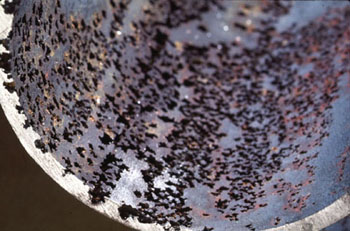

Chemical & Heat Transfer Mechanism
Poor chemistry control leads to:
Scale deposition (CaCO₃, Mg salts)
Caustic gouging
Hydrogen damage
Oxygen pitting
Thermodynamic Impact
Scale acts as thermal insulation:
Even 1 mm scale → metal temperature increase by 50–100°C.
Higher metal temperature accelerates creep exponentially.
Failure Modes
Under-deposit corrosion
Caustic embrittlement
Hydrogen blistering
Localized overheating
Journal References
• Dooley, R.B. & Bursik, A. (2011). Steam purity for turbine operation. PowerPlant Chemistry Journal.
• French, D.N. (1993). Boiler tube failures: theory and practice. Journal of Pressure Vessel Technology, ASME.
⬇️ 5️⃣ Downcomer Instability & Carryover
Fluid Dynamics Mechanism
Instability in downcomers can cause:
Water level fluctuation
Steam-water separation inefficiency
Carryover of dissolved solids into steam
When contaminated steam enters superheater:
Deposits form inside tubes
Heat transfer reduces
Tube metal temperature increases
Internal fouling + high flue gas temperature
= classic superheater overheating failure.
Journal References
• Hewitt, G.F. (2008). Two-phase flow and boiling in circulation systems.
• Rayaprolu, K. (2009). Boilers for Power and Process. CRC Press.
⏳ 6️⃣ Tube Material Exceeding Design Life
Creep Life Consumption
Creep damage accumulates according to:
Larson-Miller Parameter (LMP):
LMP = T (C + log t)
Where:
T = absolute temperature
t = rupture time
If operating hours exceed design creep life:
Grain boundary cavitation develops
Microvoid coalescence occurs
Final rupture happens even at normal stress
Journal References
• Larson, F.R. & Miller, J. (1952). Time-temperature relationship for rupture and creep stress. Transactions ASME.
• Viswanathan, R. (1989). Life assessment of high temperature components. ASM International.
📊 Summary of Failure Mechanisms
| Failure Cause | Dominant Science | Failure Type |
|---|---|---|
| Wrong material / high T | Creep mechanics | Bulging rupture |
| Poor circulation | Boiling heat transfer | Short-term overheating |
| Flame impingement | Radiative heat transfer | Local hot spot rupture |
| Poor water chemistry | Corrosion + insulation effect | Under-deposit failure |
| Carryover contamination | Internal fouling | Superheater overheating |
| Design life exceeded | Creep-fatigue interaction | End-of-life rupture |
🎯 Final Engineering Insight
Most boiler tube failures are thermo-metallurgical in nature:
They occur when:
Heat input > Heat removal
or
Stress > Allowable creep strength
or
Chemistry control fails
Effective root cause analysis requires:
✔ Metallography
✔ Hardness testing
✔ Oxide scale thickness measurement
✔ SEM fractography
✔ Operating history review
✔ Water chemistry records

No comments:
Post a Comment