Showing posts with label Palm Oil Estate. Show all posts

Wednesday, 20 August 2025

From Palm Oil Mills to Refineries: What I Learned

Not many millers make the move from upstream (mills) to downstream (refineries). It happens, but it’s rare. I was one of those who took the leap — and honestly, I made a few mistakes in my decision-making.

Why did I make the switch?
1️⃣ I trusted a close friend.
2️⃣ My family was tired of moving every few years, and my eldest child was about to sit for UPSR. Stability mattered.
3️⃣ HR at the new company painted a very attractive picture.

Looking back, I could blame these factors. But the truth is, the decision was mine. And I own it.


What Changed?

✅ Technology & Learning – Moving to a refinery meant adapting to new systems and processes. With determination, you can master them within a few years.

✅ Lifestyle – Mills are remote, quiet, close to nature. Refineries are in busy cities. The shift was huge, but it gave my family stability.

✅ Facilities – In mills, managers enjoy perks: housing, vehicles, domestic helpers. In refineries, those benefits are rare and depend on company policy.

✅ Team & Complexity – Mills may have 3–4 engineers. Refineries need large, specialized teams. Collaboration and coordination become critical.

✅ Pay & Rewards – Surprisingly, mill managers often earn more than refinery managers because upstream operations generate higher margins.


My Reflection

If you’re considering the move from upstream to downstream:

  • Don’t fear new technology — you’ll adapt.

  • Consider lifestyle and family needs carefully.

  • Be realistic about perks and compensation.

  • Remember: your problem-solving and leadership skills are transferable.

For me, the journey wasn’t perfect. But it gave me perspectives I would never have gained had I stayed in one place.

Sometimes, the value of a decision lies not in whether it was right or wrong — but in what you learned along the way.

#palmoilmill #palmoil #mpob #sawit #malaysia #indonesia #merdeka #blog #blogger #kembarainsan

From Mills to Refineries: My Journey Across the Palm Oil Industry


When I look back at my career, one of the biggest shifts I ever made was moving from the upstream side of the palm oil industry—managing mills in remote estates—to the downstream world of refineries located in the city.

If I am being completely honest, I made a few mistakes in how I approached this decision. But every mistake has its lesson, and every decision, whether right or wrong, has shaped the person I am today.


Why Did I Make the Leap?

Several factors influenced me at the time:

  1. Trust in a close friend – A friend whom I deeply respected encouraged me to take the step. I believed in his words and judgment.

  2. Family considerations – After 15 years of moving from one mill to another, constantly uprooting our lives, my family was tired. My children, especially my eldest, were entering an important stage of education with the UPSR examination. The idea of stability—one house, one school, one community—was deeply appealing.

  3. Promises from HR – The new company’s HR painted a rosy picture. They promised me that the company was strong, the management was good, and my future boss was excellent. At that moment, it sounded like the perfect opportunity.

And so, I said yes.


Acceptance and Accountability

Looking back, I could easily blame those three factors. But the truth is, the decision was mine. I chose it.

That is why today, I don’t see it as regret, but as part of my journey. I accept it as fate and as a personal test. It is also why I continue to fight and move forward—because every chapter adds to my growth, not diminishes it.


Why Share This Story Now?

Recently, a connection on social media asked me to share my perspective. He pointed out that it’s rare for a miller to switch industries and move into a refinery career path. It happens, but not often.

That is when I realized—my story might help others who are thinking about making a similar move.


Lessons from the Transition

1. Skills Transfer Across Industries

If you are an engineer or manager who constantly learns and develops yourself, you should not worry. The core of what we do—problem-solving, decision-making, managing people and operations—is transferable.

From mill to refinery, the technology may be different, but within a few years of focused learning, you will adapt.

2. Location and Lifestyle

In a mill, you live in remote estates surrounded by nature. Life is quieter, with the sounds of birds and the forest. In a refinery, you are in the heart of the city—traffic jams, busy schedules, and endless hustle.

For me, this was one of the biggest lifestyle changes. But with it also came stability for my family.

3. Facilities and Perks

Upstream managers often enjoy company bungalows, four-wheel drive vehicles, domestic helpers, and authority over the entire mill. Refineries are different—you rarely receive such perks. Everything depends on the company’s policy.

4. Workforce and Complexity

A mill may only have three or four engineers or executives. A refinery, however, requires many more engineers across specialized departments. The complexity is greater, and so is the need for teamwork and coordination.

5. Standards and Certifications

Whether mill or refinery, the industry standards (ISO 9001, ISCC, MSPO) are similar. However, refineries often require additional certifications to meet international customer requirements.

6. Salary and Rewards

This is a surprise to many. In reality, mill managers in upstream often earn more in total compensation compared to refinery managers. This is because of the high margins and critical importance of upstream operations.


Reflection

If you are standing at the same crossroad, wondering whether to leap from upstream to downstream, here is my honest reflection:

  • Don’t be afraid of learning new technologies. With dedication, you will adapt.

  • Think carefully about lifestyle and family needs. The city and the estate offer very different lives.

  • Be realistic about perks and compensation. Not every move means more rewards—it’s often a trade-off.

  • Remember, your skills are valuable. Engineers and managers who are problem-solvers can thrive anywhere.

At the end of the day, my move was not perfect. I made mistakes. I learned hard lessons. But I also gained perspectives I could never have had if I stayed in one place.

And that, to me, is worth sharing.

#palmoilmill #palmoil #mpob #sawit #malaysia #indonesia #merdeka #blog #blogger #kembarainsan

Friday, 15 August 2025

Story: Transforming Safety Culture at Gambang Palm Oil Mills


Salman Mukmin had been appointed as the Mill Manager for a cluster of palm oil mills in Gambang, Pahang. From his first week on the job, he noticed something troubling — the mills ran like clockwork in terms of production, but safety was treated as an afterthought. Helmets were sometimes worn only when visitors came. Safety briefings were rushed. A few minor accidents were brushed off as “part of the job.”
Salman knew this mindset had to change.

The Turning Point

One morning, a small incident shook him. A worker slipped on an oil spill near the loading ramp. It wasn’t serious, but it could have been far worse. That evening, Salman gathered his supervisors.

“Safety is no accident,” he began, looking around the table. “We have to stop thinking it’s just about rules. Safety is a mindset — a culture. And it starts with us.”

He introduced three key principles for his leadership team:

1. Personal Responsibility: Everyone — from the top floor to the shop floor — must own safety.

2. Proactive Prevention: “Prepare and prevent, don’t repair and repent.”

3. Empowerment to Speak Up: Every worker has the right — and duty — to stop unsafe work.

Building the Culture

Salman rolled out changes in phases:

Daily Safety Huddles: Five minutes at the start of each shift to discuss hazards, good catches, and safe work reminders.

Safety Champions: A rotation system where workers took turns leading safety inspections, making it everyone’s responsibility.

Open-door Reporting: A no-reprisal policy for raising hazards or near-misses, paired with immediate follow-up action.

He also used clear, memorable messages:

“A safe team is a strong team.”

“Shortcuts cut life short.”

“Tomorrow: your reward for working safely today.”

Resistance and Breakthrough

At first, some veteran staff muttered, “We’ve been doing this for years without all this fuss.” But Salman didn’t push with threats — he led by example.

When he personally swept oil spills, checked harness fittings, and refused to start operations until safety checks were complete, attitudes began to shift. Workers saw he was serious, not just about rules, but about their lives.

The real breakthrough came when a welder stopped a job because he felt the scaffolding was unstable. Instead of scolding him for slowing down the work, Salman thanked him in front of the team and gave him the “Safety Star” award for the month. That moment sent a clear message: safety over speed.

The Results

Within a year, near-miss reporting tripled — not because things were getting worse, but because workers now felt safe to speak up. Lost-time incidents dropped by 70%. Most importantly, safety became the norm, not an afterthought.

On the anniversary of the first safety huddle, Salman addressed the entire team:

“Safety first, safety always. We protect each other, and we go home together. That’s what makes us strong.”

And as the sun set over the oil palm estates of Gambang, the mills not only ran efficiently — they ran with a new culture of care, where every worker watched out for the next.

Sunday, 18 June 2017

Operasi Kilang Sawit / Palm Oil Mill Operation

PALM OIL MILL IS THE HEART OF OIL PALM ESTATES.
Multitasking tasks in the mill produce multitasking managers and engineers. From basic fundamental of mechanical engineering, electrical, chemical, civil, human resources, accounting, marketing, quality management, public relation, teacher, lawyer and also actor! Yes. All in one. Congratulation if you are one of them!


  1. FFB Reception

    1. Weighbridge 60 mt. One/two clerk depend on one shift or two shift.
    2. FFB Transportation. Land & Water. 


      Less maintenance vehicles.

      Safety First dude!


      Ramp and Bin System.


  2. Road is the key of estates operation.
  3. Delivering the FFB from Estates to Mills is a challenging tasks to Planters. Whenever the loaded lorry arrive at mill's gate, millers should give respect to them by accepting their consignment to appreciate their hard work. Off course for the good FFB quality.
  4. Annual calibration by Metrology / Service provider - Avery.
  5. Grading.
 
    1. Grade the FFB quality based on MPOB Grading Manual-Latest 2015 Edition.
    2. 10 category FFB. Freshness. Unripe. Underipe. Ripe. Overipe. Long stalk. Empty. Rotten. Parthonorcorpic. Rotten. Wet.
    3. Oil palm profile. To determine the based OER. Year of planted. Weight of bunch.
    4. Based OER. 
    5. Penalty based on FFB quality 
    6. Certified FFB graders by MPOB.
    7. Helper 5 to 10 psn depend on the FFB daily reception.
    8. One loader to push the FFB.
    9. Good quality FFB. 95% ripe, 5% overipe, 5% underripe.
FFB Grading based on load <5mt : 50 bunches & >5mt : 100 bunches sampling.

Loose Fruit Analysis to determine the accuracy and measure the quantity of loose fruits.

 50 Bunches FFB Sampling by Graders.

100 Bunches Sampling

Old MPOB Grading Manual.
  1. Sterilization 
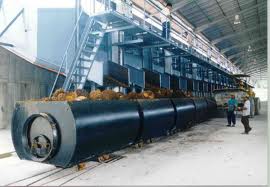
  2.  Vertical Sterilizer

    Spherical Sterilizer

    Spherical Sterilizer

    Continuous Sterilizer 

    Feeding of FFB to Vertical Steriliser

    Old style. FFB feeding to 3.5 mt Cages. Labor intensive of feedding ffb, arrranging cages and using of machinery such as loader and capstan. Safety issue and space. Maintenance of cages wear and tear.


    Spherical steriliser

    Horizontal sterilizer.

    Vertical sterilizer

    FFB Ramp, Conveyor system, Vertical Sterliser, EFB Hopper.

    1. Type of sterilizer. Horizontal. Vertical. Tilted. Spherical. Continuous. 
    2. Function : 
      1. To stop FFA increasing.
      2. To prepare the fruit/bunch for next processing.
    3. One peak, three peaks, multi peaks. 
    4. Pressure 3.2 bar or 120 deg C. 
    5. Cages size 3,5,7.5,10,15 or 20 mt each.
    6. Crane. 


    7. Dearation.
    8. Cycle.
    9. Capstan. 
    10. Cantilever. 
  3. Threshing

  4.  
    Shaft-less Thresher Drum


    Tippler use to handle the cage system.

    Tippler.
    Bunch Crusher using in Double Threshing System to reduce USB loss. Prepare the bunches for the EFB pressing or Shredding. 

    1. To separate the loose fruit and bunch.
    2. RPM.
    3. Type of threshing. with or without shaft.
    4. Single threshing or double threshing.
    5. Bunch crusher.
  5. Pressing
  6. Digester and Press


    Digester and Press

    Digester Schematic Diagram

    Digester Schematic Diagram


    Single and Double Screw Pressing

    Digester

    Cast steel screw press.

    1. Number and capacity of press determine the TPH of the mills.
    2. Capacity : 10. 15, 20, 25 mt/hr
    3. Twin screw. Cages. Screw. U liner. B plate. RH for replacement 700 to 1000 hrs.

    4. Digester. RPM. Long arm, short arm. S type. C type. Bottom plate. Temperature 95 deg C. Level 3/4. 3000 or 3500 liters capacity. 
    5. Losses. Nut breakage. Oil loss.
    6. Cake Breaker Conveyor.
  7. Nut Plant
    1. Ripple Mill. Nut breakage. Cracking Efficiency. Kernel breakage 12 to 15%.
    2. Nut Silo. Retention time.
    3. Hydrocylone or Claybatch.

      Cyclone system, Airlock using to separate the fiber, shell and kernel. Air or water separation.


      3 stages hydro-cyclone. 

      Nut Silo to retain the nut to cool down and prepare the nut before cracking. 

      Kernel Silo. Heating to reduce moisture below 7%.

      Hydrocyclone diagram.Cone and liner.

      Ripplemill. Cracking the nut. Determine the kernel breakage at range 10 to 15 % is the better option rather than cracking efficiency (96-98%). Reduce kernel loss at air separation. 

    4. Ripplermill.
    5. Kernel Bunker with load cell for weighing.
    6. Kernel losses. Shell. Dirt & Impurities.
  8. Kernel Plant
    1. Moisture.
    2. Kernel Silo. Heater.
  9. Kernel Storage
    1. Kernel bunker.
    2. To clean kernel silo and kernel bunker at least once a year to prevent fire. 
    3. Confined Space procedure to apply.
  10. Clarification 
    1. Vertical Clarifier. 

    2. Sand Trap.
    3. Pure Oil Tank
    4. Vacuum Drier. 
    5. Sludge Separator or Decanter.
    6. Sludge Tank.
      Vibrating Screen

      Decanter

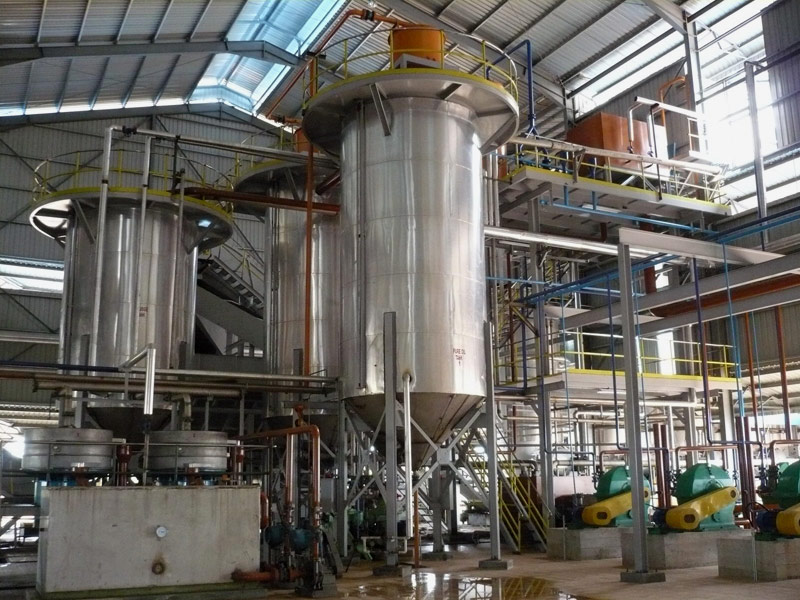
      Vertical Clarifier. Pure Oil Tank. Crude Oil Tank. Sludge Separator.

      Sludge Separator

      Purifier
    7. Deoiling Tank.
    8. Sludge Pit.
    9. Condensate Tank.
  11. Vibrating Screen. Mesh 30 or 40.
  12.  EFB 
    1. Bunch Crusher. 
    2. EFB Press. Doe requirement to put roofing. Demand for solid fuel encourage more mills to install pressing and shredding. 
       
      Handling of EFB at mills required loader. Some mills put excavator to load the efb to lorry before transfer to estates as mulching.


       Efb Press recover max 0.2% oil from EFB. High kw requirement. Less demand for pressed EFB.

       
      Combination design of EFB Press and Shredding Machine. Moisture of shredded EFB at range 40 to 45%. High demand on shredded EFB for biomass power plants and palm oil refineries. Minimum 7 days to dry out the moisture before apply to boiler due to high moisture.  
    3. Shredded EFB
    4. Palleting Machine.
    5. Long fiber. 
      Palatalize EFB for boiler fuel exported to Japan & Korea at price RM250/mt. However, the demand is less due to lots of factors.
    6. Mulching


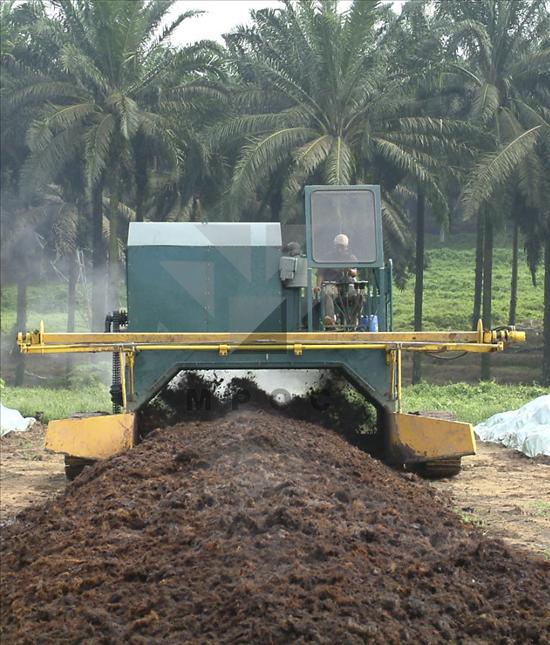
    7. Composting. 


      Nutrient contents of compost efb.
    8. EFB ratio to FFB : 23%
  13. Boiler & Power Plant
    1. Size of boiler determine by the TPH of the mills and total electricity required by all mill's sections.
    2. Ranging from 18, 27, 35, 45 mt/hr steam generating.
    3. Vickers. Mechmar. Boilermech.
    4. Water tube boiler. Biomass.
    5. Type of fuel : Mesocarp fiber. Palm kernel shell. Shreded empty bunch. Gas from Effluent treatment plant.
    6. Steam engineer. Boilerman. Engine Driver. Grade II, 1 DOSH Certificate. MSIEA. 
    7. DOSH Annual Inspection. 10 days. 
    8. Diesel Generator ranging 400, 500, 600 kw. Back up power suply during non running of steam turbine.
    9. Steam turbine to generate electricity. Ranging 1000, 1200, 1400, 2000, 2,400 kw. Nadroski. PMT.
      Water Tube Boiler


      Manual Racking for Furnace Floor without moving grate. To install Vibrating Grate or Pulsating Grate to remove clinker.

      Manual racking. Unsafe task for fireman.


      Fixed grae and moving grate

      Mesocarp fiber and palm kernel shell are sources of boiler fuel.

      Steam Turbine to generate electricity for mill operation and domestic supply.


      Working Floor to feed solid fuel to boiler. Minimize the using of loader to feed the boiler fuel.

      Mesocarp fiber. Caloric value at 3000 kj


      Adding gas from Effluent Treatment Plant to boiler.

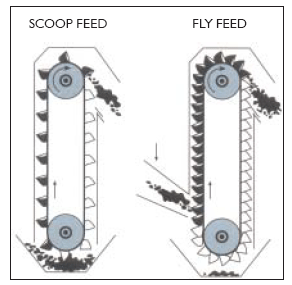
      Fuel Feeding system to boiler.
    10. Back pressure receiver. Steam supply for processing. heating.
    11. Boiler accessories. Manual racking. Pulsating grate. Vibrating grate. Soot blowing. Super heater tube. Air preheater. economizer. 
  14. Boiler water teratment. Internal treatment. Softener. Vacuum Dearator. Hot water tank. Feed water pump.

  15. Working floor. Loader. Elevator. Conveyor.  
  16. Effluent Treatment Plant


  17. Biogas System to reduce air polution. Extraction of gas for flaring or running gas turbine.


    Anaerobic Pond

    Biotube for desludging.


    Typical method of desludging. 

    Biogas at Effluent Treatment Plant

    Tanks System for ETP.


    Land Irrigation.

    Composting using sludge from mill mix with EFB.

    Aeration System.


    1. Type of ponds. Cooling Pond. Anaerobic Ponds. Aerobic Pond. Polishing Ponds.
    2. Tertiary plant. Batching System. Filtration. RO. Decanter. Belt Press. Dewatering system.
  18. Land irrigation. 
    1. Biogass. Flaring. Gas turbine.
  19. Biotube. 
  20. Desludging.
    1. PH, BOD, COD, Oil, SS. Influent parameters. 
  21. Final discharge standard parameters. Effluent. 
Filter Frame Press to reduce suspend solid. 
  1. Workshop
  2. Store
  3. Water Treatment Plant


    1. Source of water. River. Catchment pond. Man made pond. Sea. 
    2. Water intake quality determine the treatment system.
    3. Alum. Soda. PPM. Dosing system.
Pump. Clarifier. Sand filter. Pond and tanks. 

  1. Mass Transfer


    1. To convey the mass, conveyor, elevator, pump are used.
    2. Pumps. Multistage. Open Impeller. Semi. Closed Impeller. Centrifugal. 

  1. Storage Tank
    1. Tank Capacity 1000, 1500, 2000, 2500 mt.
    2. Despacth Tank.
    3. Heating.
    4. Storage procedure.


keyword for search : palm oil mill, palm oil, steriliser, thresher, digester, press, boiler, turbine, kernel silo, oer, ker, mpob, doe, dosh, water treatment plant, effluent treatment plant, efb, mesocarp fiber, shredded efb, laboratory, oil clarification, kernel silo, kernel bunker, conveyor, elevator, malaysia, sabah, borneo, ioi, boustead, engineering, mechanical, steam engineer, internal combustion engineer, genset