Showing posts with label Blog. Show all posts

Tuesday, 14 October 2025

Dari Suara Kecil ke Suara Bernilai

Ada satu perkara yang sering kedengaran di mana-mana organisasi — rungutan daripada mereka yang pesimis.

“Pengurusan tak bagi sokongan.”
“Cadangan kita tak pernah diterima.”
“Group Engineering Department tak benarkan komen pada reka bentuk projek.”
“Kalau macam ni, kita tak boleh buat apa-apa.”

Kata-kata seperti itu sentiasa berlegar di sekeliling saya pada satu ketika dahulu. Dan seperti kebanyakan orang, saya hanya mendengar. Tapi lama-kelamaan, saya tertanya-tanya — betulkah semua ini salah orang lain?

Suatu hari, saya luahkan pertanyaan itu kepada Group Engineer kami, Mr. Loh. Saya tanya dengan jujur,
“Mr. Loh, betulkah drawing semasa tender dan construction tak boleh diubah langsung?”

Beliau berpaling, pandang saya dengan wajah tegas.
Jawapannya keras, tapi membuka mata saya.

Katanya,
“Semasa tender, manager akan review drawing bersama kontraktor di site. Bila projek jalan, manager pantau dari mula sampai siap. Tapi akhirnya, mesin tak boleh beroperasi. Sekarang beritahu saya — siapa yang lebih bodoh, Group Engineer di HQ Kuala Lumpur, atau manager yang duduk di kilang hari-hari tengok kerja tu?”

Saya terdiam. Kata-kata itu terasa seperti tamparan, tapi bukan tamparan marah — tamparan kesedaran.

Sejak hari itu, saya ubah cara saya bekerja. Saya mula bersuara. Saya komen setiap lukisan, saya beri maklum balas setiap kali ada peluang. Ada yang diterima, ada juga yang ditolak. Tapi yang penting, saya tak diam lagi.

Saya belajar bahawa memberi komen bukan bermakna melawan. Ia tanda kita peduli. Ia tanda kita mahu hasil yang lebih baik.

Dan dari sikap itulah, sedikit demi sedikit, saya membina sesuatu — reputasi.
Reputasi sebagai seseorang yang berani bersuara bila orang lain diam.
Yang berani mempertahankan pendapat demi kebaikan bersama.
Yang tidak hanya mengeluh, tapi bertindak.

Kini, bila saya dengar rungutan pesimis, saya hanya senyum.
Kerana saya tahu, perubahan tak akan datang dari suara yang mengeluh — ia datang dari suara yang berani menyahut tanggungjawab.

Moralnya:
Jangan takut memberi pandangan.
Kadang-kadang, satu soalan jujur boleh mengubah seluruh cara kita memandang dunia kerja — dan juga diri sendiri.


🌴 Dari Ladang Sawit ke Dunia Kepimpinan: Sebuah Perjalanan 21 tahun 🌴

Semasa berumur 24 tahun, saya melangkah ke bumi Sabah buat pertama kali — jauh dari kampung halaman, membawa harapan dan tekad yang masih kabur. Saya tidak tahu ke mana arah hidup akan membawa saya, hanya mengikuti langkah yang terbuka di hadapan — melangkah masuk ke kilang sawit sebagai Kadet Jurutera.

Tiga tahun kemudian, di usia 27 tahun, takdir membawa saya ke satu tanggungjawab besar — dilantik sebagai Pengurus. Masih muda, masih mentah, namun realiti tanggungjawab memaksa saya belajar pantas. Mengurus manusia bukan semudah mengawal mesin. Ada jiwa, ada emosi, ada harapan di setiap wajah pekerja.

Tahun demi tahun, saya bertatih. Kadangkala tersungkur, kadangkala bangkit dengan luka yang belum sempat sembuh. Tapi langkah tetap diteruskan. Kini, hampir 19 tahun saya menakhodai organisasi dengan kekuatan 90 hingga 180 orang staf, melalui pelbagai gelombang — pasang surut ekonomi, cabaran operasi, dan juga ujian kepimpinan.

Namun saya sedar, untuk terus berdiri teguh, ilmu dan kemahiran tidak boleh berhenti di situ. Saya menyelami dunia komunikasi dan kepimpinan, menyertai Toastmasters, menghadiri kursus, dan lebih penting — belajar daripada pengalaman sebenar di lapangan.

Tahun 2014, saya tamatkan MBA, dan kemudian melangkah ke peringkat PhD dalam bidang komunikasi. Walaupun perjalanan PhD itu tidak sempat saya habiskan, namun hampir 500 jurnal ilmiah yang saya baca tentang kepimpinan dan komunikasi Rasulullah SAW telah meninggalkan kesan mendalam — membuka mata bahawa kepimpinan bukan tentang kuasa, tetapi tentang kasih, hikmah dan amanah.

Hari ini, apabila saya menoleh ke belakang, saya melihat bukan sekadar perjalanan kerjaya — tetapi perjalanan jiwa. Dari anak muda tanpa arah di Sabah, kepada seorang pemimpin yang belajar daripada setiap langkah, setiap jatuh, dan setiap kejayaan kecil.

Jika anda ingin menyelami lebih banyak kisah dan pengalaman saya sepanjang 19 tahun ini — tentang pengurusan manusia, komunikasi, dan kepimpinan sebenar di lapangan
saya jemput anda membaca perkongsian saya dan terus membaca post seterusnya!

Selamat membaca, dan semoga sedikit pengalaman saya ini menjadi inspirasi kepada perjalanan anda juga. 🌿

#blog #blogger

Sunday, 21 September 2025

Kisah Aiman dalam Latihan PALAPES TD USM


Aiman masih ingat hari pertama dia melangkah masuk ke padang kawad PALAPES TD USM. Matahari terik, kasut but berat, dan jeritan kawad serentak bergema di udara. Bagi kebanyakan mahasiswa, hujung minggu adalah masa untuk berehat, tetapi bagi Aiman dan rakan-rakannya, ia adalah medan mengasah disiplin, mental dan fizikal.

1. Disiplin yang Membentuk

Latihan bermula seawal subuh. Barisan terbentuk tepat pada waktunya. Tiada alasan, tiada kompromi. Sedikit sahaja kesilapan kawad, seluruh platun terima akibatnya. Dari situlah Aiman belajar erti tanggungjawab—bahawa satu kesilapan kecil boleh memberi kesan kepada seluruh pasukan.

2. Tidur di Ladang dan Hutan

Bukan sekali dua mereka diuji dengan latihan medan. Pernah mereka tidur di ladang sawit yang baru ditanam, di ladang getah, malah di hutan yang gelap pekat. Tidur beralaskan tanah, berbumbungkan langit, ditemani bunyi unggas malam.
Bagi Aiman, ketidakselesaan itu bukan beban, sebaliknya pengalaman berharga. Di situlah dia belajar bertahan, menerima keadaan, dan menyesuaikan diri.

3. Cabaran Fizikal dan Mental

Latihan lasak kadang-kadang membuatkan tubuh terasa ingin menyerah. Lari jauh dengan beban penuh, merangkak dalam lumpur, menyeberang sungai dengan senjata di tangan—semuanya menguji batas diri. Tetapi setiap kali Aiman mahu berhenti, dia teringat rakan di kiri dan kanan. PALAPES mengajar bahawa perjuangan bukan tentang diri sendiri, tetapi tentang pasukan.

4. Nilai Kepimpinan

Sebagai pegawai kadet, Aiman mula belajar bahawa kepimpinan bukan sekadar memberi arahan. Ia tentang mendengar, memahami, dan mendahulukan pasukan. Ada masa dia perlu jadi contoh—berani di hadapan, tenang dalam tekanan. Ada masa dia perlu mengakui kelemahan, lalu bangkit bersama-sama.

5. Universiti Kehidupan

Bila orang bertanya bagaimana dia boleh bertahan dalam industri yang keras selepas graduasi, Aiman selalu menjawab:
“Sebab saya PALAPES.”

Pengalaman tiga tahun itu bukan sekadar latihan ketenteraan, tetapi universiti kehidupan. Ia melatihnya menghargai disiplin, bersedia menghadapi cabaran, dan sentiasa mencari jalan untuk menyelesaikan masalah, bukan lari daripadanya.


Pengajaran:
Kisah Aiman dalam PALAPES TD USM adalah bukti bahawa cabaran dan ketidakselesaan adalah guru terbaik. Apa yang ditempa dalam ladang sawit, hutan, dan padang kawad, menjadi bekalan untuknya menempuh dunia kerjaya dan kehidupan sebenar.

Monday, 8 September 2025

📖 Kisah Hana – Mencari Potensi dalam Semua Orang

Hana selalu percaya bahawa seorang pemimpin sejati bukan sahaja melihat keadaan semasa seseorang pekerja, tetapi juga membayangkan siapa mereka boleh jadi jika diberi peluang dan kepercayaan.

Stephen R. Covey pernah mendefinisikan kepimpinan sebagai:
"Leadership is to communicate to another person their worth and potential so well they begin to see it in themselves." [^1]

Cabaran di Kilang

Hana dan pasukannya sedang menghadapi minggu yang kritikal kerana juruteknik kanan perlu menghadiri kursus luar bandar selama beberapa hari. Dalam masa yang sama, mesin sterilizer yang sangat penting dalam operasi kilang menunjukkan tanda-tanda tidak stabil.

Biasanya, juruteknik kananlah yang menjadi troubleshooter utama. Tetapi kali ini, Hana perlu membuat keputusan cepat – siapa boleh ambil alih tanggungjawab sementara?

Di hadapan Hana ada tiga staf muda:

Azri, juruteknik baru berusia 23 tahun yang rajin tetapi kurang keyakinan.

Mira, jurutera proses muda, sangat teliti tetapi sering rasa dirinya “belum cukup bagus.”

Faizal, operator berpengalaman sederhana, cekap tetapi jarang diberi tanggungjawab besar.

Memberi Kepercayaan

Dalam satu mesyuarat ringkas, Hana bertanya seorang demi seorang apa yang mereka tahu dan mampu lakukan. Akhirnya, dia berkata:

> “Kalau begitu, sebenarnya awak semua dah tahu apa yang perlu dibuat. Cuma tinggal satu perkara saja – sanggup tak awak semua buat kerja ini tanpa banyak alasan, saling tolong, dan ambil tanggungjawab penuh?”

Mereka bertiga mengangguk penuh yakin.

Hari Ujian

Hari itu akhirnya tiba. Juruteknik kanan tiada di kilang, Hana pula perlu menghadiri mesyuarat luar. Walaupun risau, Hana percaya pasukannya mampu berdiri sendiri.

Petang itu, apabila Hana kembali ke kilang, dia dapati sterilizer bukan sahaja beroperasi stabil, malah kawasan kerja lebih kemas. Azri tunjuk laporan troubleshooting, Mira tambah catatan kawalan proses, dan Faizal pastikan semua operator patuh dengan arahan.

Refleksi Hana

Hana berkata kepada mereka:

> “Inilah sebabnya saya percaya dengan pasukan saya. Kamu semua bukan sahaja buat kerja dengan baik, tapi tunjukkan potensi sebenar bila diberi peluang.”

Sejak hari itu, Hana semakin yakin bahawa dengan bimbingan, kejelasan, dan kepercayaan, seseorang akan naik ke tahap yang kita tidak sangka.

👉 Pengajaran Hana:
Pemimpin bukan sekadar mengurus kerja, tetapi membina keyakinan dalam diri orang lain. Bila kita letakkan trust dengan kawalan risiko yang wajar, kita akan terkejut dengan potensi yang muncul.

#blog #blogger #kembarainsan #usm #ukm #um #utm #habit #leader #leadership #anekdot

Thursday, 4 September 2025

🌴 Hana’s Story: Building Trust in Her Palm Oil Mill


Hana had been managing her palm oil mill for nearly a decade. She knew that technical expertise alone was not enough to keep the plant running smoothly. Machines could be repaired, boilers could be overhauled, but human trust—once broken—was much harder to fix.

One day, during a scheduled maintenance shutdown, a major issue surfaced. The workers discovered cracks in one of the key boiler components. Some employees whispered that management might cover it up to save costs. Hana sensed the tension in the air.

Instead of hiding, Hana gathered her team in the workshop. With sincerity, she explained the issue openly, acknowledged the risks, and invited suggestions on how to proceed. She emphasized that safety would always come before profits. The room was silent at first, but slowly, voices began to rise. Technicians shared their concerns, operators suggested preventive steps, and the maintenance head proposed a long-term plan.

By involving her team, Hana demonstrated cognitive-based trust (confidence in their competence) and affective-based trust (valuing their relationships and emotions)¹. The workers saw that she trusted their expertise and respected their input.

Weeks later, when the boiler was safely repaired, Hana noticed a transformation. Employees worked with renewed energy, communication flowed more openly, and even small tasks were carried out with greater care. Trust had become the “lubricant” that kept her mill’s organizational engine running without unnecessary friction².

Hana realized that her true role was not just to manage machines, but to build an environment where people trusted each other and their leader. That trust, once nurtured, turned into collective strength that no technical failure could easily break.

Rujukan penuh:
Dirks, K. T., & Ferrin, D. L. (2001). The role of trust in organizational settings. Organization Science, 12(4), 450–467.

📌 Apa yang artikel ini bincangkan:
Artikel ini ialah literature review yang sangat berpengaruh dalam bidang psikologi organisasi & pengurusan, khususnya tentang peranan kepercayaan (trust) dalam tempat kerja.

🔑 Isi utama artikel:

  1. Definisi Trust

    • Trust dilihat sebagai kepercayaan bahawa orang lain akan bertindak dengan niat baik, jujur, dan boleh diandalkan walaupun ada risiko.

    • Mereka tekankan bahawa trust bukan sekadar emosi, tapi melibatkan ekspektasi terhadap tingkah laku pihak lain.

  2. Dua Dimensi Trust

    • Cognitive-based trust → berdasarkan kompetensi & kebolehan. Contohnya, seorang pekerja percaya kepada jurutera senior sebab tahu dia mahir.

    • Affective-based trust → berasaskan hubungan & emosi, contohnya percaya sebab ada hubungan baik, sokongan, dan empati.

  3. Kesan Trust dalam organisasi

    • Kerjasama meningkat – pekerja lebih rela berkongsi maklumat & bekerjasama.

    • Prestasi lebih baik – pasukan dengan tahap trust tinggi lebih inovatif & berdaya tahan.

    • Konflik berkurang – kerana ada rasa saling percaya dan tidak mudah salah sangka.

    • Kepimpinan lebih berkesan – pemimpin yang membina trust lebih mudah menggerakkan orang lain.

  4. Trust sebagai “lubricant” organisasi

    • Mereka gunakan analogi bahawa trust ibarat pelincir dalam mesin organisasi: ia tidak kelihatan, tetapi tanpa trust, semua proses jadi lambat dan penuh geseran.

  5. Model Cadangan

    • Artikel ini mencadangkan rangka kerja (framework) tentang bagaimana trust terbina, faktor yang mempengaruhi, dan akibatnya terhadap hasil organisasi.

📖 Kenapa penting?

  • Artikel ini sering dijadikan rujukan utama (highly cited, lebih 10,000 citation di Google Scholar) dalam kajian kepimpinan, kerjasama pasukan, HR, dan komunikasi organisasi.

  • Ia bantu pemimpin & pengurus faham bahawa membangun trust lebih penting daripada sekadar mengawal atau memerintah.

#hana #blog #blogger #trust #leader #leadership #manager #management 


Saturday, 30 August 2025

🌿 Hana and the Journey to Authentic Happiness

The Early Years – Chasing Comfort

When Hana first began her career as a young engineer, she thought happiness meant earning a good salary, buying nice clothes, and going on vacations once in a while. She worked hard at the palm oil mill, but every evening she felt a strange emptiness.

> “Why do I feel tired even when I have everything I thought I wanted?” she often asked herself.

She was living only in the Pleasant Life — chasing comfort, laughter, and leisure.

The Turning Point – Finding Flow

One evening, while reviewing machine breakdown logs, Hana realized something unusual. She was so absorbed in analyzing the data that hours passed without her noticing. The noise of the mill, the fatigue, even hunger disappeared.

That was her first taste of Engagement — being in flow, completely immersed in something meaningful. She discovered she loved problem-solving and improving systems.

From then on, she pushed herself to apply her skills more deeply. Preventive maintenance systems, safety SOPs, and energy-efficiency programs became her passion projects.

The Deeper Purpose – Beyond Herself

Years later, Hana noticed how her efforts in the mill created ripple effects. Accidents reduced. Workers’ lives became safer. Energy savings were redirected to support workers’ families, even helping children get school aid.

Watching a worker’s child proudly show her a scholarship letter, Hana felt tears in her eyes.

> “This is why I work. Not just for myself, but for something bigger.”

This was The Meaningful Life — using her strengths for a cause beyond her own comfort.

Optimism in Hardship

Not everything went smoothly. Projects failed. Floods damaged equipment. Colleagues doubted her leadership as a woman.

But Hana practiced optimism: she treated failures as temporary and challenges as lessons. Instead of saying, “I’m not good enough,” she told herself, “This is a chance to grow.”

The Gratitude Habit

Every night before bed, Hana wrote down three things she was grateful for:

1. A successful test run of the biogas plant.

2. A smile from her junior engineer who solved a problem.

3. Her mother’s voice on the phone reminding her to rest.

Over time, this small ritual filled her life with lightness and joy, even on stressful days.

Conclusion – The Authentic Happiness

Hana finally realized that true happiness isn’t just about pleasure. It is about:

Enjoying life’s simple joys (Pleasure),

Losing herself in meaningful work (Engagement), and

Serving a greater cause (Meaning).

Standing on the mill’s balcony one evening, watching Mount Kinabalu in the distance, Hana whispered to herself:

> “Happiness is not found. It is built — with gratitude, strength, and purpose.”

And in that moment, she knew she had discovered her own authentic happiness.

#blog #blogger #kembarainsan #happy #happiness #engineer #reflection

Thursday, 28 August 2025

🌱 Hana and the Power of One “Yes”


One evening, after a long day at the mill, Hana read an article about J.K. Rowling — a single mother who wrote Harry Potter in the midst of hardship.

Rejected by 12 publishers, she refused to give up. At last, one small publisher, Bloomsbury, said “Yes”. That single decision transformed Rowling’s life and the lives of millions of readers.

Hana closed the magazine and reflected:

"If Rowling could write in the middle of struggle, why should I stop when facing setbacks at the mill? If she endured rejection after rejection, why should I quit when my proposals are declined or when my ideas are overlooked?"

🌟 Turning Inspiration into Action

The next day, Hana carried that lesson into her workplace.

When her safety proposal was rejected, she returned with stronger data.

When her wastewater treatment plan was ignored, she presented an alternative.

When production targets fell short, she reminded her team:
👉 “We may fall 12 times, but one breakthrough can change everything.”

🌴 The Leadership Lesson

Over time, Hana discovered that Rowling’s resilience was not only about writing — it was about leadership.

She often told her young managers:

> “Success isn’t about how many times you’re rejected. It’s about how long you keep moving until you hear that one ‘Yes.’ Sometimes, one open door is all you need to change your destiny.”

💡 Leadership Takeaways

Rowling’s story gave Hana three lasting lessons:
1️⃣ Rejection is not the end – rejection is part of the journey, not the destination [1].
2️⃣ Consistency beats talent – discipline and persistence create breakthroughs more than raw talent [2].
3️⃣ One Yes can change destiny – perseverance ensures you’re still standing when opportunity arrives [3].

📚 References

[1] Gladwell, M. (2008). Outliers: The Story of Success. Little, Brown & Company.
[2] Duckworth, A. (2016). Grit: The Power of Passion and Perseverance. Scribner.
[3] Grant, A. (2016). Originals: How Non-Conformists Move the World. Viking.

Amir’s Life Truths by Age 40

1. Leverage, Not Just Hard Work

Amir once worked 16-hour days in the mill, but his salary barely changed. Only when he learned to delegate, train others, and create systems did his value multiply. He realized wealth wasn’t about working harder, but about leveraging time and talent [1].

2. Distraction is an Assassin of Dreams

Living in a remote estate, Amir sometimes drowned in distractions — endless TV shows, idle chatter. He failed his steam engineer exam more than once. Each failure was a painful reminder that distractions silently kill ambition [2].

3. Choose Voices Carefully

Everyone had advice for him — some said, “Leave the palm oil industry, it’s too hard.” But Amir chose to listen only to mentors who had walked the same road. Their wisdom carried weight, while others’ opinions were just noise [3].

4. No Hero is Coming

During his early days in Lahad Datu, Amir injured his hand while repairing a mill gate. No one came to rescue him. He endured the hospital nights alone, learning that no savior would appear. His destiny rested in his own hands [4].

5. Less Reading, More Doing

Amir loved motivational books, but soon realized theory alone couldn’t save him. Progress came only when he acted — joining Toastmasters, sitting for exams, and writing his blog. Discipline, not theory, moved him forward [5].

6. The Power of Sales

Though an engineer, Amir once worked as a sales engineer. Learning how to persuade, connect, and sell ideas helped him rise faster in management. He saw that sales was not just about products — it was about influence [6].

7. People Think of Themselves More Than You

For years Amir feared sharing ideas, worrying about criticism. Later he learned: most people were too busy with their own lives to think about him. Once he realized this, he stepped forward boldly into leadership [7].

8. Walk Beside the Wise

At first Amir envied senior managers. Then he humbled himself, walked beside them, and asked questions. Slowly, their wisdom rubbed off, shaping him into a stronger leader [8].

9. Smoking Steals Clarity

Amir never smoked, but he saw its effects on colleagues — sluggish thinking, clouded judgment, tired faces. He decided early: nothing that stole clarity was worth the cost [9].

10. Comfort is a Poison

Life in plantations was comfortable enough — steady salary, simple living. But Amir knew staying too long in comfort would poison his growth. He chose discomfort — moving mills, taking exams, facing change. That discomfort built his resilience [10].

11. Guard Your Privacy

Since 2009, Amir wrote blogs. But he never shared everything. Family conflicts, office politics — he kept private. Peace, he realized, was worth far more than public curiosity [11].

12. Avoid Alcohol

As a Muslim, Amir never touched alcohol. Yet he saw brilliant men humiliated in one night because of it. That was enough lesson: dignity once lost is hard to regain [12].

13. Hold Your Standards High

When tempted with jobs that paid more but clashed with his principles, Amir refused. Standards mattered more than convenience. His worth, he believed, was not negotiable [13].

14. Build Your Family with Intention

Amir didn’t just admire other families. He built his own intentionally — loving his wife Arni, raising five children with values and faith. For him, true success was measured at the dinner table, not just in the boardroom [14].

15. Take Nothing Personally

Amir faced criticism, gossip, and betrayal. Early in his career, he took everything personally. But maturity taught him: not every battle was his to fight. By letting go of ego, his peace grew stronger [15].

16. Faith First

Through failures, betrayals, depression, and victories, Amir returned to faith. By placing God first, he found clarity in chaos. Everything else eventually aligned [16].

Reflection

By age 40, Amir’s truths were not just lessons — they were scars, experiences, and faith woven into his journey. His story reminds us: wisdom is not read, it is lived.

References

[1] Covey, S. (1989). The 7 Habits of Highly Effective People. Free Press.
[2] Newport, C. (2016). Deep Work: Rules for Focused Success in a Distracted World. Grand Central Publishing.
[3] Maxwell, J. (2007). The 21 Irrefutable Laws of Leadership. Thomas Nelson.
[4] Frankl, V. (1946). Man’s Search for Meaning. Beacon Press.
[5] Duhigg, C. (2012). The Power of Habit. Random House.
[6] Carnegie, D. (1936). How to Win Friends and Influence People. Simon & Schuster.
[7] Brown, B. (2012). Daring Greatly. Gotham Books.
[8] Collins, J. (2001). Good to Great. HarperBusiness.
[9] WHO (2019). Global Report on Tobacco Use. World Health Organization.
[10] Grant, A. (2021). Think Again. Viking.
[11] Nissenbaum, H. (2010). Privacy in Context. Stanford University Press.
[12] National Institute on Alcohol Abuse and Alcoholism (2018). Alcohol’s Effects on the Body. NIH.
[13] Rumelt, R. (2011). Good Strategy Bad Strategy. Crown Business.
[14] Chapman, G. (1992). The 5 Love Languages. Moody Publishers.
[15] Carnegie, D. (1948). How to Stop Worrying and Start Living. Simon & Schuster.
[16] Holy Quran, Surah Al-Baqarah 2:2.

#blog #blogger #kembarainsan #life #above40

Wednesday, 27 August 2025

🎖️ Hana dan Loreng Hijau: Sebuah Kisah ROTU

Tahun 1999, Hana melangkah ke Universiti Sains Malaysia, Pulau Pinang dengan harapan menjadi jurutera mekanikal. Namun takdir memberinya lebih daripada sekadar ilmu kejuruteraan — ia memberinya jiwa seorang perwira.

🌱 Hari-Hari Awal: Denda & Disiplin

Di padang kawad, derap but menghentak bumi.
"Bangun! Push up seratus kali!" suara jurulatih membelah pagi.

Hana, yang belum pernah diuji sebegitu, jatuh bangun dengan tubuh berpeluh, lutut melecet, telapak tangan perit. Ada hari dia menangis sendirian di asrama. Tetapi setiap kali tubuhnya mahu menyerah, hatinya berbisik:
👉 “Jika aku mahu jadi pemimpin, aku mesti tahan ujian ini.”

🪖 Latihan Tahunan: Hutan & Pertahanan

Musim cuti semester bukan untuk pulang bercuti. Ia dihabiskan di kem tahunan ROTU.

Hana belajar bertahan dalam hutan – tidur beralaskan daun, makan ransum keras yang dikongsi tiga orang. Malam, nyamuk hutan berdesing, dan mereka berjaga dalam senyap, memegang senjata, menjaga perimeter.

Dalam latihan pertahanan, mereka menggali parit perlindungan, tubuh berlumur lumpur, hujan mencurah tanpa belas. Tetapi setiap senyuman dari rakan seperjuangan menjadi api semangat yang menghangatkan jiwa.

🔥 CIW & Latihan Serangan

Hana masih ingat ketika latihan Close Interval Weapon (CIW) — menahan keletihan sambil mengawal senjata, berlari, merangkak, menjerit dalam koordinasi. Nafasnya sesak, tubuhnya hampir rebah, tetapi dia bangkit lagi.

Dalam latihan serangan, mereka mara ke hadapan, jeritan “GERAK!” menggetarkan hutan. Debaran jantung berpadu dengan hentakan but, seakan bumi pun bergetar menyaksikan tekad anak muda yang sedang ditempa jadi wira.

🌴 Kenangan Manis & Ikatan Persaudaraan

Di sebalik kepayahan, ada tawa yang tidak pernah padam.

Gelak ketawa ketika berkongsi air masak dari tin periuk.

Nyanyian senandung di khemah sambil menahan kesejukan.

Semangat “sehidup semati” yang terjalin antara mereka, tanpa mengira kaum dan latar belakang.

Itulah kenangan manis ROTU — persaudaraan dalam loreng hijau.

🌟 Hari Pentauliahan 2002

Tibalah tahun 2002. USM menjadi tuan rumah Majlis Pentauliahan Pegawai Kadet.

Padang kawad dipenuhi ribuan penonton, pancaragam tentera memainkan lagu penuh wibawa. Hana berdiri dalam uniform putih penuh, pedang di sisi, wajahnya bercahaya meski mata bergenang.

Saat namanya dipanggil, langkahnya tegap ke hadapan. Pedang diserahkan, pangkat disematkan. Dari seorang mahasiswi, kini dia bergelar Leftenan Muda Hana.

Air mata jatuh, bukan kerana penat, tetapi kerana syukur. Semua luka, denda, latihan hutan, dan malam tanpa tidur akhirnya menjadi permata pengalaman yang abadi.

💡 Refleksi Hana

Bertahun kemudian, bila berdepan cabaran di kilang sawit atau dunia korporat, Hana sering berkata kepada anak buahnya:

> “Aku pernah tidur di hutan, berlari dengan senjata, ditegur, didenda, menangis, dan bangkit semula. ROTU mengajar aku bahawa kepimpinan bukan lahir dari jawatan, tapi dari kesanggupan menahan ujian. Itulah darah loreng yang kekal di hati.”

#blog #palapes #usm #rotu #hana #usm #campus #wataniah 

🌱 Hana and the Measure of a Good Heart


The refinery yard was always full of noise — machines roaring, tankers lining up, and operators rushing with clipboards. But amidst all that noise, what truly defined Hana as a leader was not only her knowledge or discipline, but her heart.

She believed leadership was not just about managing processes, but about shaping people through kindness, honesty, and integrity. Over time, her team discovered the nine quiet signs that revealed Hana’s good heart.

1️⃣ Kindness in Action

When a harvester injured his hand, Hana didn’t just sign the accident report. She visited him in the hospital, brought his family food, and told him, “Your health matters more than production.”
Her kindness echoed louder than any policy.
➡️ Studies show kindness in leadership increases employee engagement and organizational trust [1].

2️⃣ Honesty Without Excuse

During an audit, Hana discovered a mistake in the mill’s reporting. Instead of hiding it, she admitted it openly:
"We missed this. It’s my responsibility."
Her honesty built trust, even with regulators.
➡️ Honesty is a core leadership trait tied to credibility and integrity [2].

3️⃣ Staying Humble

Though she was the manager, Hana never sat apart. In the canteen, she ate the same food, at the same tables, as her workers.
She often said, “The palm oil doesn’t know rank. It grows because we all do our part.”
➡️ Humility in leadership fosters collaboration and loyalty [3].

4️⃣ Never Gossiping

When workers complained about each other, Hana never fueled the gossip. She listened quietly and then said, “Let’s hear both sides before judging.”
She created fairness where rumors once divided.
➡️ Leaders who discourage gossip promote psychological safety and trust in teams [4].

5️⃣ Keeping Promises

She once promised a mandore that if yields improved, she’d fight for better equipment. Months later, when results came, she fulfilled her word. A new set of tools arrived, and so did the mandore’s loyalty.
➡️ Keeping promises is a fundamental part of “trust currency” in leadership [5].

6️⃣ Taking Responsibility

When the mill faced downtime, outsiders pointed fingers. Hana stood before the board and said:
"Don’t blame my team. The responsibility is mine."
And then, she worked with her team to fix it.
➡️ Great leaders take responsibility and share credit, strengthening organizational resilience [6].

7️⃣ Respect for Everyone

From clerks to contract workers, Hana greeted each person by name. She listened as much to a harvester’s story as to an engineer’s report. Respect was not selective; it was consistent.
➡️ Respect is one of the most universal values employees seek in a leader [7].

8️⃣ Helping Without Expecting

On weekends, Hana often helped the estate schoolchildren with their studies. She asked for nothing in return — only that they, too, would one day help others.
➡️ Acts of selfless service strengthen social bonds and leadership credibility [8].

9️⃣ Doing What’s Right (Even When It’s Hard)

When pressured to cut safety corners for faster output, Hana stood firm:
"We will not trade lives for numbers."
It was not the easy path — but it was the right one.
➡️ Ethical leadership is about making the right decisions under pressure, even at personal or organizational cost [9].

🌺 The Legacy of Hana’s Heart

Over the years, her refinery and mills improved not just in production, but in people. Workers trusted her. Young managers respected her. Communities loved her.

Because leadership is not measured by how much power you have.
It is measured by how much goodness you bring.

Hana showed that:

> Kindness builds trust. Honesty builds respect. Humility builds loyalty. And a good heart builds leaders who inspire others long after the machines fall silent.

📚 References

[1] Cameron, K. (2013). Practicing Positive Leadership: Tools and Techniques That Create Extraordinary Results. Berrett-Koehler.
[2] Kouzes, J.M., & Posner, B.Z. (2017). The Leadership Challenge. Jossey-Bass.
[3] Owens, B.P., & Hekman, D.R. (2016). “How does leader humility influence team performance? Exploring the mechanisms of contagion and collective promotion focus.” Academy of Management Journal, 59(3), 1088–1111.
[4] Edmondson, A.C. (2019). The Fearless Organization: Creating Psychological Safety in the Workplace for Learning, Innovation, and Growth. Wiley.
[5] Covey, S.M.R. (2006). The Speed of Trust. Free Press.
[6] Maxwell, J.C. (2011). The 5 Levels of Leadership. Center Street.
[7] Brown, M.E. & Treviño, L.K. (2006). “Ethical leadership: A review and future directions.” The Leadership Quarterly, 17(6), 595–616.
[8] Greenleaf, R.K. (1977). Servant Leadership: A Journey into the Nature of Legitimate Power and Greatness. Paulist Press.
[9] Kidder, R.M. (2009). How Good People Make Tough Choices: Resolving the Dilemmas of Ethical Living. HarperCollins.

#blog #blogger #kembarainsan #malaysia #leadership #manager

🌱 Hana and the Gift of Trust

When Hana was promoted to Mill Manager, she inherited a team that was tired, doubtful, and cautious. Years of strict rules and micromanagement had made them silent — they followed orders, but their eyes carried no spark.

One morning, Hana walked into the workshop and saw a young technician struggling with a pump alignment. His hands trembled, and his supervisor stood nearby, ready to take over.

"Leave it," the supervisor said, "he’ll break it."

But Hana shook her head. She bent down beside the young man and said softly:
"I trust you. Take your time. You’ll get it right."

The workshop fell silent. The young man’s hands steadied. Minutes later, the pump aligned perfectly. A smile broke across his face, and the room seemed lighter.

🌟 The Ripple of Trust

From that day, Hana began practicing what Abraham Lincoln once said:
“It’s better to trust people and be disappointed once in a while than to distrust and be miserable all the time.”

She gave supervisors more say in scheduling harvest rotations.

She let engineers propose their own maintenance improvements.

She invited clerks to speak during morning briefings.

Not every idea was perfect. Not every attempt succeeded. But the more she trusted, the more her people grew.

🌴 The Transformation

One year later, the same mill was unrecognizable.

Workers spoke up with pride.

Managers stepped forward with confidence.

Even the quietest mandore began guiding his team with energy.

And when auditors came, they were amazed not only at the mill’s efficiency but at the spirit of ownership in every corner.

🌺 The Lesson

Hana often told her young managers:

"Trust is not weakness. It is a seed. Plant it in people, water it with belief, and you will harvest confidence you never imagined."

She knew that someone once trusted her when she was new, untested, and afraid. And now it was her turn to pass on the gift.

Because leaders who trust, build leaders who rise.
#blog #blogger #kembarainsan #engineer #palmoilmill #nilai #sabah #sarawak #kelantan

🌱 Hana and the Art of Delegation

When Hana was promoted to Country Head, she suddenly found herself responsible for ten estates, three mills, and one large refinery.
At first, she tried to do everything herself — every report, every meeting, every decision.

The result? She was exhausted, and her managers were waiting passively for her instructions.
She realized: “If I don’t learn to delegate, I will fail. But if I empower others, we all succeed.”

🌟 1. Choosing What to Delegate

One evening, Hana reviewed her workload. She circled tasks she alone must keep — strategic vision, board reporting, key safety accountability.
Then she marked tasks she could pass on — estate manuring schedules, mill maintenance planning, refinery stock audits.

She remembered a leadership principle: Delegate tasks that grow others while freeing you for higher-level leadership [1].

🔑 2. Matching the Task to the Right Person

At Ladang Semarak Estate, Hana saw a young assistant with strong initiative but little confidence. She gave him responsibility for the fertilizer program.
At the refinery, she chose her most meticulous supervisor to handle quality audits.
She knew: Delegation is not about dumping tasks. It’s about matching responsibility to skill and growth potential [2].

📢 3. Communicating the Vision

In every handover, Hana explained not just the task, but the why.

To the estate assistant:
"This isn’t just about manuring. Each tree you nourish increases yield, which feeds families and supports livelihoods. Your work is part of a bigger story."

Clear communication of outcomes, boundaries, and purpose is the heart of effective delegation [3].

⚙️ 4. Providing Resources and Support

She ensured the estate assistant had data from past yield records, enough labor force, and proper training.
She gave the refinery supervisor access to updated ISO manuals and audit software.
Hana knew that delegation without resources is abdication [4].

🕒 5. Setting Milestones and Checkpoints

Hana never vanished after delegating.
She set review dates: weekly updates from estates, monthly reports from the refinery, quarterly cross-audits.
This balance of trust with accountability kept people engaged without feeling micromanaged [5].

💡 6. Allowing Mistakes as Learning

The estate assistant once miscalculated fertilizer rates. Losses occurred.
Instead of punishment, Hana sat with him, analyzed the error, and told him:
"Failure is tuition. What matters is what you learn."

Leadership experts confirm that mistakes under supportive delegation become powerful development opportunities [6].

🌺 7. Recognizing and Growing Leaders

At year’s end, the assistant became confident, the refinery supervisor was promoted, and even the mandore felt more ownership.
Hana saw the ripple: delegation was not about reducing her workload.
It was about multiplying leaders.

🌴 The Transformation

The company thrived — yields improved, audits ran smoother, and morale rose.

At the annual gathering, Hana shared her reflection:

> “At first, I thought leadership was about how much I could do myself. Now I know — true leadership is about how many others I can help grow. Delegation is not losing control. It is gaining capacity.”

And the applause that followed wasn’t just for Hana. It was for the leaders she had built.

📚 References

[1] Drucker, P. (2006). The Effective Executive: The Definitive Guide to Getting the Right Things Done. HarperBusiness.
[2] Maxwell, J.C. (2011). The 5 Levels of Leadership. Center Street.
[3] Yukl, G. (2012). Leadership in Organizations (8th ed.). Pearson.
[4] Covey, S.R. (1989). The 7 Habits of Highly Effective People. Free Press.
[5] Blanchard, K. & Hersey, P. (1988). Management of Organizational Behavior: Utilizing Human Resources. Prentice Hall.
[6] Goleman, D. (2013). Primal Leadership: Unleashing the Power of Emotional Intelligence. Harvard Business Review Press.

#blog #blogger #manager #delegation #management #people #kembarainsan #estate #mill #engineer

Tuesday, 26 August 2025

🎙️ Storytelling and Leadership: Why It Matters

Leadership is not only about strategy, structure, or systems.
It’s about inspiring people, shaping culture, and moving hearts as well as minds.

That’s where storytelling comes in. It transforms abstract values, tough lessons, or complex visions into something memorable and human.


🔑 1. Storytelling Creates Connection

  • A story makes a leader relatable.

  • Instead of quoting numbers or issuing commands, leaders who tell stories connect emotionally with their teams.

💡 Example: A mill manager telling about the time she once failed a safety audit, and how she learned to prioritize chemical segregation, is far more impactful than just saying “Follow SOP.”

📚 Reference: Denning, S. (2011). The Leader’s Guide to Storytelling.


🔑 2. Storytelling Clarifies Vision and Purpose

  • Data informs. Stories inspire.

  • Vision statements often sound corporate and distant. But if a leader wraps it in a story — why the mission matters, who benefits, and how success looks in real life — it sticks.

💡 Example: Instead of saying “We must improve yield by 5%,” a leader tells a story of how better yield means more scholarships for estate workers’ children. Suddenly, the vision becomes personal.

📚 Reference: Kouzes & Posner (2017). The Leadership Challenge.


🔑 3. Storytelling Transmits Culture and Values

  • Stories are carriers of values.

  • When leaders share stories of honesty, courage, or resilience, they show what the organization truly stands for.

💡 Example: Sharing how an operator once stopped production to prevent an accident — and was rewarded, not punished — reinforces the value of safety first.

📚 Reference: Guber, P. (2011). Tell to Win: Connect, Persuade, and Triumph with the Hidden Power of Story.


🔑 4. Storytelling Motivates and Builds Resilience

  • People remember stories of struggle and triumph more than rules or procedures.

  • Stories remind teams that obstacles are temporary and growth is possible.

💡 Example: A leader telling how she used to juggle work, family, and night classes — and still grew into a manager — inspires perseverance in her staff.

📚 Reference: Brown, B. (2015). Rising Strong.


🔑 5. Storytelling Shapes Decision-Making

  • Leaders often need to influence without authority.

  • A well-told story can shift perspectives faster than logic alone.

💡 Example: Instead of pushing for a new ETP (effluent treatment plant) investment purely with cost-benefit analysis, telling the story of a nearby mill fined heavily due to pollution makes the point sharper.

📚 Reference: Simmons, A. (2006). The Story Factor.


🌱 Storytelling as an Art in Leadership

✔️ Art = Creativity: Leaders must weave lessons into narratives, not lectures.
✔️ Art = Emotion: Stories stir emotions that drive action.
✔️ Art = Practice: Like any art, storytelling improves with practice — knowing your audience, timing, and tone.

When applied correctly, storytelling:

  • Inspires commitment rather than compliance.

  • Builds leaders at every level by teaching through lived experiences.

  • Transforms managers into visionary leaders.


💡 Leadership Takeaway

👉 Facts tell. Stories sell.
👉 Rules instruct. Stories inspire.
👉 Strategies direct. Stories unite.

A leader who learns the art of storytelling doesn’t just manage people.
They move them, grow them, and transform them.

#blog #blogger #leadership #story #leader #manager

🧯 Hana and the Safe Mill: A Story of Chemical Stewardship

The palm oil mill was alive with its usual rhythm — boilers steaming, conveyors moving, and trucks rumbling in with fresh fruit bunches. But this time, Hana, the mill manager, had a different mission.

She wasn’t only thinking about production.
She was thinking about safety.

One morning, during her inspection, she noticed a half-empty drum of hydrochloric acid placed near a pallet of caustic soda. Her heart tightened. She knew this wasn’t just poor housekeeping — it was a potential disaster.


1. Segregating Chemicals by Compatibility

Hana called her supervisors and said:

"Acids don’t belong near bases. Flammables can never sit beside oxidizers. If they react, one mistake can cost lives."

She introduced color-coded shelves — red for acids, blue for bases, yellow for flammables. With one glance, workers could tell where each chemical belonged.

Chemical incompatibility is a leading cause of accidents in storage areas, and segregation is the first line of defense [1].


2. Using the Right Storage Units

Next, Hana took them to the chemical shed.

She pointed to the paint thinners and solvents: "These are flammable. They must stay inside fire-resistant, ventilated cabinets."

Then, she showed the sulfuric acid drums: "For corrosives, no more rusty metal racks. From today, we use coated shelves that resist corrosion."

Even the oxygen and LPG cylinders had new places — strapped upright with chains, safely away from heat.

Proper storage infrastructure is proven to reduce risk of fire, leaks, and gas cylinder accidents [2].


3. Labeling and Signage

One afternoon, Hana gathered the clerks. She handed them rolls of labels.

"Every container gets a proper name, hazard class, and the date it was received or opened," she instructed.

They also posted hazard signage outside the storage area: NFPA diamonds, GHS symbols, and bold words: CAUTION – CHEMICAL STORAGE.

Clear labeling and signage not only comply with law but also improve hazard communication for all personnel [3].


4. Maintaining Ventilation

Hana walked the team to the back of the storage shed. The air was heavy with the faint smell of solvent.

"Do you feel this?" she asked. "That’s vapor. Without ventilation, it builds up until one spark makes it deadly."

She ordered local exhaust fans for volatile storage and made sure windows stayed open to keep air flowing.

Adequate ventilation prevents accumulation of flammable or toxic vapors, a well-documented best practice [4].


5. Controlling Environmental Conditions

Finally, Hana reminded them about the little things:

  • Keep drums away from direct sunlight.
  • Store chemicals above flood levels to avoid water contact.
  • Check temperature and humidity in sensitive storage.

Environmental factors often trigger chemical deterioration, reactivity, and leaks — making monitoring essential [5].


🌴 The Transformation

Months later, auditors visited the mill. The chemical storage areas were no longer chaotic corners — they were models of discipline and safety.

The auditor smiled: “This is beyond compliance. This is leadership.”

Hana looked at her team with pride. She knew the changes weren’t about rules on paper. They were about protecting lives.

And as she left the shed, she whispered to herself:
"Production builds profit. Safety builds people. And people are the true strength of a mill."


📚 References

[1] U.S. Occupational Safety and Health Administration (OSHA). Chemical Hazard Communication and Compatibility Guidelines. 2022.
[2] NFPA 30. Flammable and Combustible Liquids Code. National Fire Protection Association, 2021.
[3] Globally Harmonized System of Classification and Labelling of Chemicals (GHS). United Nations, 2021.
[4] U.S. Environmental Protection Agency (EPA). Ventilation and Storage Requirements for Hazardous Chemicals. 2020.
[5] Chemical Safety Board (CSB). Case Studies in Chemical Storage and Environmental Controls. 2022.

#blog #blogger #chemical #dosh #jkkp #kembarainsan #malaysia 

🌱 Creating My Own Positive Circle 🌱

I used to scroll Facebook and LinkedIn hoping to find something positive to feed my mind for the day. Instead, I was often flooded with politics and negativity — things that are not my concern and not how I want to start my day.

That’s when I made a choice: instead of consuming, I started creating.
I began writing my own blogs and posts, shaping my own stories, building my own world, and nurturing my own circle.

Whenever I see negativity, I reject it, remove it, and move forward. Life is too short to let other people’s noise cloud our growth.

✨ If you enjoy my stories and reflections, feel free to share them.
Together, we can create a circle filled with positivity, inspiration, and growth.

#blog #blogger #kembarainsan #malaysia #palmoilmill

Sunday, 24 August 2025

Bill Gates’s Lifelong Love of Reading

1. Reading = Lifelong Learning

  • Gates has said, “You don’t start getting old until you stop learning. Every book teaches me something new or helps me see things differently.”(Medium)

  • This reflects his belief that reading keeps the mind active, curious, and continuously growing.

2. From Childhood Encyclopedias to Weekly Reads

  • Growing up, Gates devoured the entire set of World Book encyclopedias, which fired up his curiosity across countless subjects(TIME).

  • Even now, he tries to maintain a pace of roughly one book per week(TIME)—a habit that has spanned decades.

3. Tools of the Trade: Notebooks, Tote Bags, and Printed Books

  • Despite the rise of digital reading, Gates prefers physical books, often jotting notes in the margins for deeper engagement(TIME).

  • Whether traveling or relaxing, he always brings along a canvas tote bag full of books(TIME).

4. Reading Broadens Perspectives

  • He doesn’t just stick to nonfiction; fiction and memoirs feed empathy and imagination. For example, he’s praised works like Seveneves (science fiction) and the emotionally resonant The Heart(TIME).

  • Reading helps him explore new ideas, cultures, and emotions—effects that textbooks alone can’t provide.

5. Reading Fuels His Philanthropic Vision

  • Gates credits reading for inspiring his worldview and guiding his philanthropic strategies—especially his optimism rooted in the idea that "the world is getting better"(TIME).

  • He frequently recommends books that shaped his thinking, such as Steven Pinker’s The Better Angels of Our Nature(TIME).

6. 2025: A Year of Reflection and Influence

  • In May 2025, after publishing his memoir Source Code, Gates shared his summer reading list: five memoirs that influenced how he crafted his own life story(Gates Notes).

  • He reflected on how reading informed his writing process—bringing narrativ

    e depth, vulnerability, and clarity to his own memoir(Gates Notes).


Summary: Why Reading Matters to Bill Gates

Aspect Insight
Mindset & Growth Reading keeps him intellectually engaged and open to new ideas—“you don’t start getting old until you stop learning.”
Habits & Tools Prefers printed books, reads weekly, always travels with a tote of books, and annotates deeply.
Breadth of Reading Balances nonfiction learning with fiction for empathy and creativity.
Philanthropic Roots Reading shaped his worldview and continues to inform his philanthropic choices.
2025 & Beyond His memoir and summer reading list illustrate how reading continues to guide his storytelling and self-understanding.

In short, that statement—"you don’t start getting old until you stop learning"—is more than a quip. It encapsulates Bill Gates’s ongoing reading habit, which is central to his creativity, leadership, philanthropy, and worldview—even as recently as 2025. He doesn’t just read for pleasure; he reads to continually grow, empathize, and evolve.

📌 Summary

For Gates, reading is a tool of renewal and reinvention:

  • It keeps him curious.

  • It broadens his perspective.

  • It inspires his leadership and philanthropy.

  • Even in 2025, it continues to shape his personal storytelling.

His mantra—"you don’t start getting old until you stop learning"—remains the guiding force behind his lifelong reading journey.


📚 Footnotes & References

  1. Gates on lifelong learning and reading: Medium – Mind Café

  2. Gates reading encyclopedias & one book per week: Time Magazine – Reading Habits

  3. Physical books and tote bag habit: Time – Gates’ Favorite Hobbies

  4. Fiction and nonfiction balance: Time – Gates’ Book Recommendations

  5. Pinker’s influence on Gates’ worldview: Time – Gates Reading Choices

  6. Summer 2025 reading list & memoir reflection: GatesNotes – Summer Books 2025


👉 #blog #blogger #kembarainsan #leader #management #billgates #book #reading 

📖 Hana and the Habit That Transformed Her Leadership

The palm oil refinery was always alive — boilers roared, trucks queued, and instruments blinked endlessly. But Hana, the mill manager, knew that running a refinery wasn’t just about machines. It was about the mind behind the decisions.

Early in her career, she struggled. Reports piled up, breakdowns drained her energy, and her team looked to her for answers she sometimes didn’t have. She realized one thing: if she wanted to grow as a leader, she had to keep learning — every single day.

1. Learning Like Warren Buffett

Hana began dedicating one hour every morning to reading. Annual reports, industry journals, even biographies of engineers who built great plants.
Just as Buffett read for 5+ hours a day to build “compound knowledge” [1], Hana treated reading as fuel. Slowly, her decision-making sharpened. She could see patterns others missed.

2. Embracing Bill Gates’ Curiosity

She didn’t limit herself to technical manuals. Inspired by Gates’ wide reading — from history to science to fiction [2] — Hana picked up books on psychology, leadership, and even novels.
These stories helped her see her workers not just as “operators,” but as people with dreams and struggles. Reading deepened her empathy.

3. Drawing Inspiration Like Elon Musk

Hana remembered how Elon Musk devoured books as a child, sometimes 10 hours a day [3]. While she couldn’t match that, she filled her evenings with pages instead of endless TV. Every book opened a new world, and soon she was connecting refinery problems with ideas from space, economics, and biology.

4. Reflecting Like Executives at Goldman Sachs

Each month, Hana chose one impactful book or speech to reflect on with her team. She believed, like global executives, that diverse sources of wisdom shaped resilience and judgment [4].
Her team began sharing summaries of their own readings, turning “book talks” into part of mill culture.

5. Practicing Emotional Intelligence Through Reading

One night, Hana read a novel about hardship in a fishing village. The next day, when an operator came late to work, instead of scolding, she asked about his family. He was struggling with his father’s illness.
Reading had taught her emotional intelligence — the skill leaders need most [5].

🌱 The Transformation

Over time, Hana’s refinery began to thrive. Not just in production numbers, but in people.
Her team trusted her decisions, respected her empathy, and admired her wisdom.

When asked her secret, Hana would smile and say:
"Machines run on oil. Leaders run on knowledge. And the best way to fuel your mind is by reading every single day."

📚 References

[1] Investopedia. Warren Buffett Reading Habit. 2025.
[2] Time Magazine. Bill Gates on His Lifelong Love of Reading. 2025.
[3] World Economic Forum. 9 Successful People Share Their Reading Habits. 2025.
[4] Business Insider. Goldman Sachs Executives on Books and Leadership Lessons. 2024.
[5] IESE. Reading Fiction Helps Executives Lead Better. 2025.

#book #read #management #manager #powerofnnowledge #palmoilmill #engineer #blog #blogger

Wednesday, 20 August 2025

The calm within the storm


Haris was a plant manager at a palm oil refinery on the east coast. Every morning, before the first whistle of the turbine echoed across the mill yard, he would scroll through his phone. Headlines of economic crises, endless political quarrels, workplace gossip in the group chats, and even personal attacks on social media were everywhere. The noise was endless.

At first, Haris used to let it get under his skin. A single negative post about his management style could haunt him throughout the day. A heated argument on social media left him restless at night. In meetings, he carried this emotional baggage, making him impatient with his team.

But years of experience taught him one golden lesson: not all things deserve his attention.

He began to practice a discipline he called the art of filtering. Each morning, after reading the news and messages, he would ask himself:

Is this within my control?

Does this add value to my day or my people?

Will reacting to this bring peace or only more noise?

Slowly, he built his own mental filter. Gossip among staff? He smiled and walked past. Negative posts on social media? He scrolled on. Political noise? He focused on what he could control — production targets, equipment reliability, and the well-being of his team.

In the evenings, when the boilers quieted and the shift handover was complete, Haris would sit on the verandah of his quarters, looking at the estate stretching into the horizon. The sound of crickets, the rustling palm leaves, and the fading sunset reminded him that true peace comes not from controlling the world, but from controlling the entry points of the heart.

Over time, his calmness became a shield. Workers respected him because he never reacted hastily to rumours. His superiors valued his steady hands during turbulent times. Most importantly, his family cherished a man who, despite the storm of information around him, always came home with a peaceful smile.

Haris knew now: ignoring is not weakness. It was wisdom. It was strength. It was the quiet power that allowed him to protect both his plant and his own inner world.

✨ Moral: Just like a plant manager filters impurities from crude palm oil to produce golden refined oil, we too must filter the noise of life — gossip, unnecessary drama, and meaningless conflict — to produce peace within ourselves.

Would you like me to make this into a LinkedIn-style post version (shorter, punchy, with key takeaways), or keep it as a long-form reflective article like above?
Here’s a story version for you, Hashim, based on the theme “Seni Mengabaikan Demi Ketenangan” but placed in the life of a plant manager:

The Story: The Calm Within the Storm

Haris was a plant manager at a palm oil refinery on the east coast. Every morning, before the first whistle of the turbine echoed across the mill yard, he would scroll through his phone. Headlines of economic crises, endless political quarrels, workplace gossip in the group chats, and even personal attacks on social media were everywhere. The noise was endless.

At first, Haris used to let it get under his skin. A single negative post about his management style could haunt him throughout the day. A heated argument on social media left him restless at night. In meetings, he carried this emotional baggage, making him impatient with his team.

But years of experience taught him one golden lesson: not all things deserve his attention.

He began to practice a discipline he called the art of filtering. Each morning, after reading the news and messages, he would ask himself:

Is this within my control?

Does this add value to my day or my people?

Will reacting to this bring peace or only more noise?

Slowly, he built his own mental filter. Gossip among staff? He smiled and walked past. Negative posts on social media? He scrolled on. Political noise? He focused on what he could control — production targets, equipment reliability, and the well-being of his team.

In the evenings, when the boilers quieted and the shift handover was complete, Haris would sit on the verandah of his quarters, looking at the estate stretching into the horizon. The sound of crickets, the rustling palm leaves, and the fading sunset reminded him that true peace comes not from controlling the world, but from controlling the entry points of the heart.

Over time, his calmness became a shield. Workers respected him because he never reacted hastily to rumours. His superiors valued his steady hands during turbulent times. Most importantly, his family cherished a man who, despite the storm of information around him, always came home with a peaceful smile.

Haris knew now: ignoring is not weakness. It was wisdom. It was strength. It was the quiet power that allowed him to protect both his plant and his own inner world.

✨ Moral: Just like a plant manager filters impurities from crude palm oil to produce golden refined oil, we too must filter the noise of life — gossip, unnecessary drama, and meaningless conflict — to produce peace within ourselves.

#Leadership #Mindset #PersonalGrowth #CalmLeadership #PlantManagerLife #kembarainsan #blog #malaysia #sabah #sarawak

Wednesday, 23 April 2025

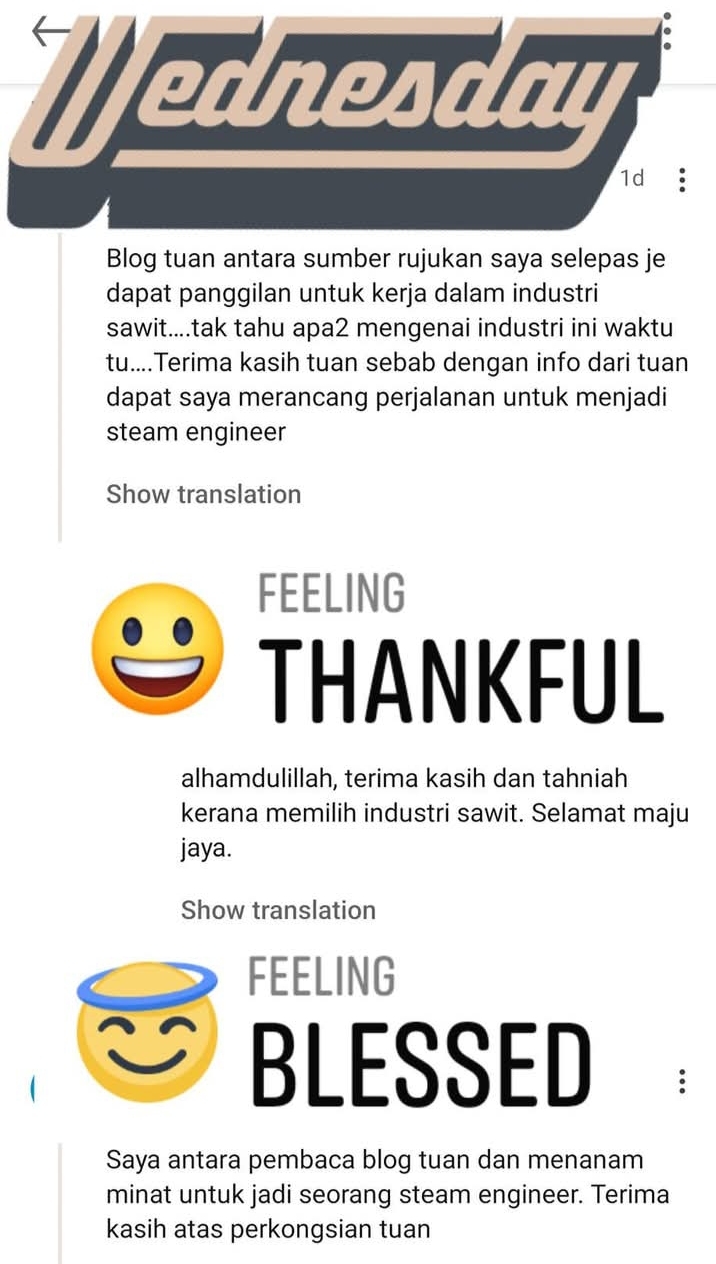
Terima kasih atas maklumbalas pembaca blog

Apa yang kau cari dalam hidup?

Self satisfaction, redha Allah. Beberapa hari lepas saya post infographic Kembara Insan menggunakan Chatgpt. Post di Linkldn dan mendapat komen dari salah seorang pembaca blog saya.

Komen ini amat menyentuh hati saya kerana maklumbalas tersebut telah memberikan kejayaan ke atas tujuan asal blog tersebut mula ditulis sejak 2009. 

Saya amat gembira kerana mampu berkongsi sedikit pengalaman dengan generasi muda pewaris kepada lapisan pengerak industri sawit pada masa akan datang. 

Terima kasih.

Saturday, 12 October 2024

Tiga cara mudah buka akaun blog

 Tiga langkah mudah buka akaun blog

1. Buka akaun Gmail.

2. Sign in di page Blogger.com

3. Mula menulis

Semoga bermanfaat