
Clear, industry-grade explanation of GLYCERIN (GLYCEROL) from the palm oil industry—covering where it comes from, how it’s produced, and what the world uses it for.
🧴 Glycerin from Palm Oil Industry
Process • Grades • Final Products
1️⃣ What is Glycerin?
Glycerin (glycerol) is a colorless, odorless, sweet, hygroscopic liquid alcohol.
Why it matters:
Safe (food & pharma grades)
Water-soluble
Excellent humectant (retains moisture)
Biodegradable & renewable when palm-based
👉 Palm oil is the largest renewable source of glycerin globally.
2️⃣ Where Glycerin Comes From (Palm Value Chain)
Glycerin is not the main product—it is a by-product from two major processes:
A. Fat Splitting (Hydrolysis) – Oleochemical Route
Palm / PK Oil + Water → Fatty Acids + Glycerin
B. Transesterification – Biodiesel Route
Palm Oil + Methanol → Methyl Ester (Biodiesel) + Glycerin
👉 About 10% by weight of oil becomes glycerin.
3️⃣ Glycerin Process Flow (Step-by-Step)
🔁 High-Level Flow
Palm Oil / PKO / PFAD
        ↓
 Fat Splitting or Transesterification
        ↓
   Sweet Water (10–20% glycerin)
        ↓
 Evaporation & Distillation
        ↓
  Crude Glycerin
        ↓
 Refining & Polishing
        ↓
 Final Glycerin Grades
4️⃣ Detailed Process Explanation
① Fat Splitting / Biodiesel Reaction
High pressure & temperature (fat splitting)
Catalyst & methanol (biodiesel)
Output:
Fatty acids / methyl ester (main product)
Sweet water containing glycerin
② Sweet Water Concentration
Glycerin content: 10–20%
Multi-effect evaporators remove water
Produces crude glycerin (80–88%)
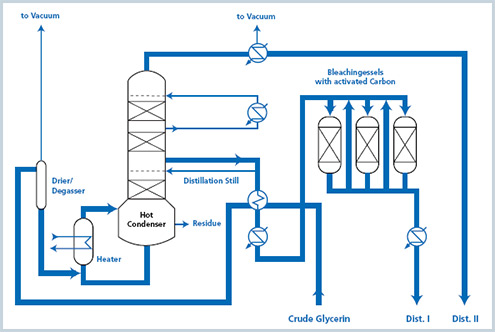
③ Glycerin Distillation
Vacuum distillation
Removes:
Salts
Methanol
Color bodies
Odor compounds
④ Polishing & Refining
Depending on grade:
Ion exchange
Carbon treatment
Fine filtration
5️⃣ Glycerin Grades from Palm Oil
| Grade | Purity | Main Uses |
|---|---|---|
| Crude glycerin | 80–88% | Industrial, energy |
| Technical grade | 95–98% | Chemicals, resins |
| USP / Pharma grade | ≥99.5% | Medicine, cosmetics |
| Food grade | ≥99.5% | Food & beverage |
👉 Higher purity = much higher value
6️⃣ Mass Balance (Rule of Thumb)
From 1,000 kg palm oil:
Fatty acids / biodiesel: ~900 kg
Glycerin: ~100 kg
After refining:
~85–90 kg refined glycerin
7️⃣ Final Products Made from Palm-Based Glycerin
🧼 Personal Care (Largest Market)
Soap
Shampoo
Toothpaste
Body lotion
Cosmetics
Function: Moisturizer, texture, stability
🍬 Food & Beverage
Sweetener
Humectant (keeps food soft)
Food coating
Found in:
Bakery
Candy
Processed food
💊 Pharmaceutical & Medical
Syrups
Capsules
Cough medicine
Creams & ointments
👉 Must be USP / EP grade
🧪 Industrial & Chemical
Resins
Polyols
Antifreeze
Lubricants
Alkyd paints
🚗 Energy & Specialty
Fuel additives
Biogas substrate
Explosives (nitroglycerin)
E-liquid / vape
8️⃣ Why Palm-Based Glycerin Dominates
Compared to synthetic glycerin:
| Palm-Based | Synthetic |
|---|---|
| Renewable | Petrochemical |
| Lower carbon footprint | Higher emissions |
| Food & pharma safe | Limited use |
| Global scale | Niche |
🔑 Engineer’s Insight
Glycerin was once waste
Today it is a strategic co-product
Profitability depends on:
Purification level
Market access
Integration with oleochemical plants
🧠 Final Takeaway
Palm oil doesn’t just feed the world—it hydrates it, heals it, and cleans it through glycerin.
From cooking oil → chemistry → medicine → daily life
Here’s a clear, data-backed overview of global glycerin demand by industry — showing which sectors consume glycerin and why it matters for the palm oil and oleochemical value chain:
🌍 Global Glycerin Demand by Industry
Glycerin (glycerol) is a versatile chemical produced mainly as a co-product from:
biodiesel production
oleochemical splitting of fats/oils
Palm-based glycerin is a major part of the global supply because palm oil and palm kernel oil are widely processed worldwide.
Below are the key demand segments and their relative importance:
1️⃣ Personal Care & Cosmetics
💧 Largest single global segment (~30–40%+)
Used as a humectant, emollient, moisturizer, and solvent
Found in lotions, creams, shampoos, soaps, toothpaste, deodorants, etc.
Rising demand tied to natural and plant-based formulations.
👉 This segment typically accounts for ≈30–42% of global glycerin use.
2️⃣ Pharmaceuticals & Healthcare
💊 Major growing segment (~20–25%)
Used as solvent, sweetener, excipient, and stabilizer
Common in cough syrups, capsules, ointments, wound care products
Pharmaceutical grade glycerin demand is increasing with stricter purity requirements.
👉 Around 20–25% of glycerin goes into medical and healthcare uses.
3️⃣ Food & Beverages
🍭 Significant demand (~15–30%)
Functions as a humectant, sweetener, and texture enhancer
Used in bakery goods, confectionery, beverages, low-sugar products
Recognized as safe by regulators such as the FDA.
👉 Shares vary by report source but often fall in the 15–30% range.
4️⃣ Industrial & Chemical Applications
🏭 Important segment (~10–15%)
Feedstock for derivatives such as propylene glycol, epichlorohydrin, solvents, resins
Used in adhesives, antifreeze, plastics, coatings, and rubber.
👉 Industrial uses typically represent ≈10–15% of total glycerin consumption.
5️⃣ Biodiesel / Biofuels (Indirect demand)
⚡ Driven by production, not direct use
Glycerin itself is a by-product of biodiesel (FAME) manufacture
Biodiesel output contributes significantly to glycerin supply (≈60% from biodiesel pathways) — this boosts supply rather than direct end-use demand.
👉 While this isn’t a direct demand sector, it fundamentally shapes global glycerin availability and pricing.
📊 Approximate Breakdown (Typical Range)
Here’s a consolidated, approximate view of how glycerin demand is distributed globally:
| Sector | Typical % of Total Glycerin Demand |
|---|---|
| Personal Care & Cosmetics | ~30–40% |
| Pharmaceuticals & Healthcare | ~20–25% |
| Food & Beverages | ~15–30% |
| Industrial & Chemical | ~10–15% |
| Other (emerging uses) | ~5% |
Note: Actual market share can vary by region and reporting source, but most credible market analyses align with this broad distribution.
🔎 Emerging & Niche Applications
In addition to the major sectors above, glycerin demand is also rising in:
Bio-based polymers and biodegradable plastics
Tobacco humectants
Specialty chemicals for coatings, textiles, and lubricants
Animal nutrition and feed additives
Green solvents and chemical intermediates
These niche uses are smaller by volume but significant for innovation and value creation.
🧠 Key Trends Driving Demand
✔ Rising global population and middle-class consumption
✔ Growth in personal care and cosmetic markets
✔ Increasing pharmaceutical production and aging populations
✔ Health and wellness trends boosting food and beverage use
✔ Shift to renewable and bio-based chemicals
✔ Expansion of biodiesel production increasing glycerin supply and availability
📌 Final Insight
Glycerin has evolved from a by-product to a high-value industrial chemical with broad global demand across food, health, personal care, and industrial applications. Its versatility and safety make it indispensable across sectors.

No comments:
Post a Comment